


A client called me last week about a refinance offer. He’s a 2023 homeowner sitting on a 7% mortgage, and his lender just offered him 5.875%.
“This drops my payment $465 a month. Should I do it?”
I asked for the full proposal. He sent one page. One scenario. New 30-year loan at 5.875%. His monthly payment would drop from $3,326 to $2,861.
Total interest over the life of the loan: $650,000.
Payoff date: 2056
Compared to staying at 7%, it looked like a clear win. Lower payment, better rate, less total interest.
But I had a question.
Why only one option? Why didn’t they show him a 25-year term? Or a 20-year? If rates dropped enough to make refinancing worth it, wouldn’t a shorter term save him even more?
That one-page proposal wasn’t showing him the full picture. They gave him one path forward. The one that keeps him in debt the longest. And there’s other options that could save him six figures more—his lender just didn’t mention it.
I’ve seen this same pattern often with homeowners who locked in at 7% back in 2023. Rates are finally dropping enough to make refinancing worth the effort, and now the offers are flooding inboxes. Everyone’s asking the same question: “How much can I drop my monthly payment?”
But, that’s exactly the wrong question to ask—and most lenders are counting on you not knowing better.
Why lenders lead with the 30-year option
Lenders aren’t hiding the ball. They’re optimizing for what’s easiest to sell.
A lower monthly payment is the simplest pitch in mortgage lending. You pay less starting immediately. That’s an easy yes. Explaining why a higher payment might be smarter requires more math and more risk you’ll walk away.
The second reason is structural. Longer loans generate more interest income. A 30-year mortgage at 5.875% on $500,000 generates about $650,000 in total interest. A 25-year term at 5.75%? Closer to $533,000.
Their incentives and your wealth-building goals aren’t perfectly aligned. The lender benefits when you stay in debt longer. You benefit when you get out faster.
What the numbers actually show
Here’s what my client’s lender didn’t show him. Three scenarios side by side:
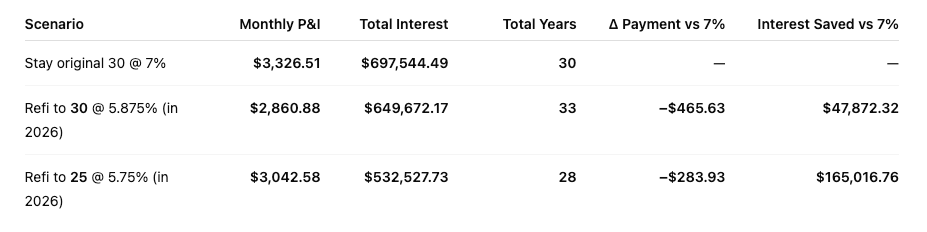
Look at that fourth column: Total Years.
When you refinance into a new 30-year mortgage after already paying on your loan for three years, you’re not reducing your debt timeline. You’re extending it. My client’s original mortgage would have been paid off in 2053.
The “better” refinance his lender offered? Pushes that to 2056.
That’s three extra years of monthly payments. Three more years before he owns his house outright. Three more years the bank has a claim on his income.
The 25-year option? Paid off in 2051.
Two years ahead of his original schedule. Still drops his payment by $283 a month. And saves him $117,000 more in total interest than the 30-year refi path.
Same rate environment. Same refinance moment. Completely different outcome.
How to think about your own scenario
The 30-year refinance isn’t wrong.
If you need maximum monthly flexibility right now, it still beats staying at 7%. And some people prefer the lower payment specifically to invest the difference—betting they can earn better returns elsewhere than the interest rate they’re paying. That’s a legitimate play if you’re disciplined about deploying that capital.
But if you’re optimizing for wealth efficiency and time freedom, a shorter term could win. Less total interest. Faster payoff. More wealth compounding in your name instead of the bank’s.
The 25-year term works for my client. But that’s not the only option.
Depending on your cash flow and goals, a 20-year or even 15-year term might make more sense. The point isn’t to pick a specific number—it’s to see the full menu and understand the tradeoffs.
Here’s how to evaluate your situation. Ask your lender to run multiple scenarios—30-year, 25-year, 20-year, 15-year. Then compare three numbers:
Monthly payment vs. your current bill. Which terms fit your budget?
Total interest across the full loan. How much are you saving by shortening the timeline?
Final payoff date. When do you want to be debt-free?
All three tell the story. If a 20-year payment fits your budget and gets you debt-free faster, that might be your answer. If you need the cash flow for other investments, the 30-year path still moves you forward.
Just make sure you’re seeing all the options before you sign.
That’s it.
My client hasn’t refinanced yet. He’s still reviewing both options with his lender.
But here’s what changed: he went from “this looks like a no-brainer” to “show me all the scenarios before I decide anything.”
That’s the shift that matters. Not the lowest payment. Not the easiest yes. The full picture.
Your mortgage isn’t just a monthly expense. It’s a claim on your future income. Every year you cut off that timeline is a year you own your time—not the bank.
Most people will refinance this year focused entirely on lowering their payment. They’ll sign proposals that look good on paper but quietly stretch their debt another three years.
You don’t have to.
Next time a lender sends you a refinance offer, ask for both scenarios. Compare the full picture. Then choose the path that builds wealth, not just cash flow.
See you next week.


Whenever you’re ready, there are 2 other ways we can help you:
30-Day Strategy Sprint: Got a specific financial challenge holding you back? In just 30 days, we’ll tackle 1-3 of your biggest money roadblocks and hand you a personalized action plan. Perfect if you want expert guidance without a long-term commitment. Limited spots available.
Ongoing Wealth Partnership: We’ll work with you month after month to slash your taxes, find hidden income opportunities, and build lasting wealth. You set the life goals. We handle the financial strategy to get you there faster.
Opulus, LLC (“Opulus”) is a registered investment advisor in Pennsylvania and other jurisdictions where exempted. Registration as an investment advisor does not imply any specific level of skill or training.
The content of this newsletter is for informational purposes only and does not constitute financial, tax, legal, or accounting advice. It is not an offer or solicitation to buy or sell any securities or investments, nor does it endorse any specific company, security, or investment strategy. Readers should not rely on this content as the sole basis for any investment or financial decisions.
Past performance is not indicative of future results. Investing involves risks, including the potential loss of principal. There is no guarantee that any investment strategies discussed will result in profits or avoid losses.
All information is provided “as-is” without any warranties, express or implied. Opulus does not warrant the accuracy, completeness, or reliability of the information presented. Opinions expressed are those of the authors, Ryan Greiser and Francis Walsh, and are subject to change without notice.
Opulus is not responsible for any errors or omissions, nor for any direct, indirect, or consequential damages resulting from the use or reliance on this information. Use of the content is at your own risk. This content is not intended as an offer or solicitation in any jurisdiction where such an offer or solicitation would be illegal.
💯 And even if the lender doesn't provide other options, the borrower can still create their own optionality.
The borrower can take out a 30-year loan and make larger than minimum monthly payments to effectively shorten the life of the loan (provided the loan terms allow prepayments). Just because the contractual loan term is 30 years doesn't mean you can't plan to pay it off in 25 years, or 20 years, or whatever period you choose.
This would obviously require more discipline on the part of the borrower, but that's where a good CFP like Ryan can be of assistance!