


A friend of mine runs her own business, and she texted me last week in a mild panic. Her Q3 numbers came in way higher than she’d projected back in January, and she was thinking about a tax bill that could be tens of thousands more than she’d planned for.
Her question: “Am I about to get crushed with penalties?”
Here’s the thing almost nobody knows until they’re in this exact situation: there’s a rule built into the tax code that protects you from a penalty even if you end up owing $50,000 more than expected at filing. It’s called safe harbor, and it exists specifically for people whose income doesn’t come in a neat, predictable paycheck.
Q3 estimated taxes are due today. So if you’ve been avoiding this conversation, today’s the day to have it.
Let’s dig in ↓
Why This Penalty Exists
The IRS wants its money throughout the year, not just in one lump sum every April. If you underpay along the way, whether through withholding or estimated payments, you’re charged an underpayment penalty at filing.
Safe harbor is the built-in exception. Hit one of two thresholds, and the penalty simply doesn’t apply, no matter how much you end up owing when you file.
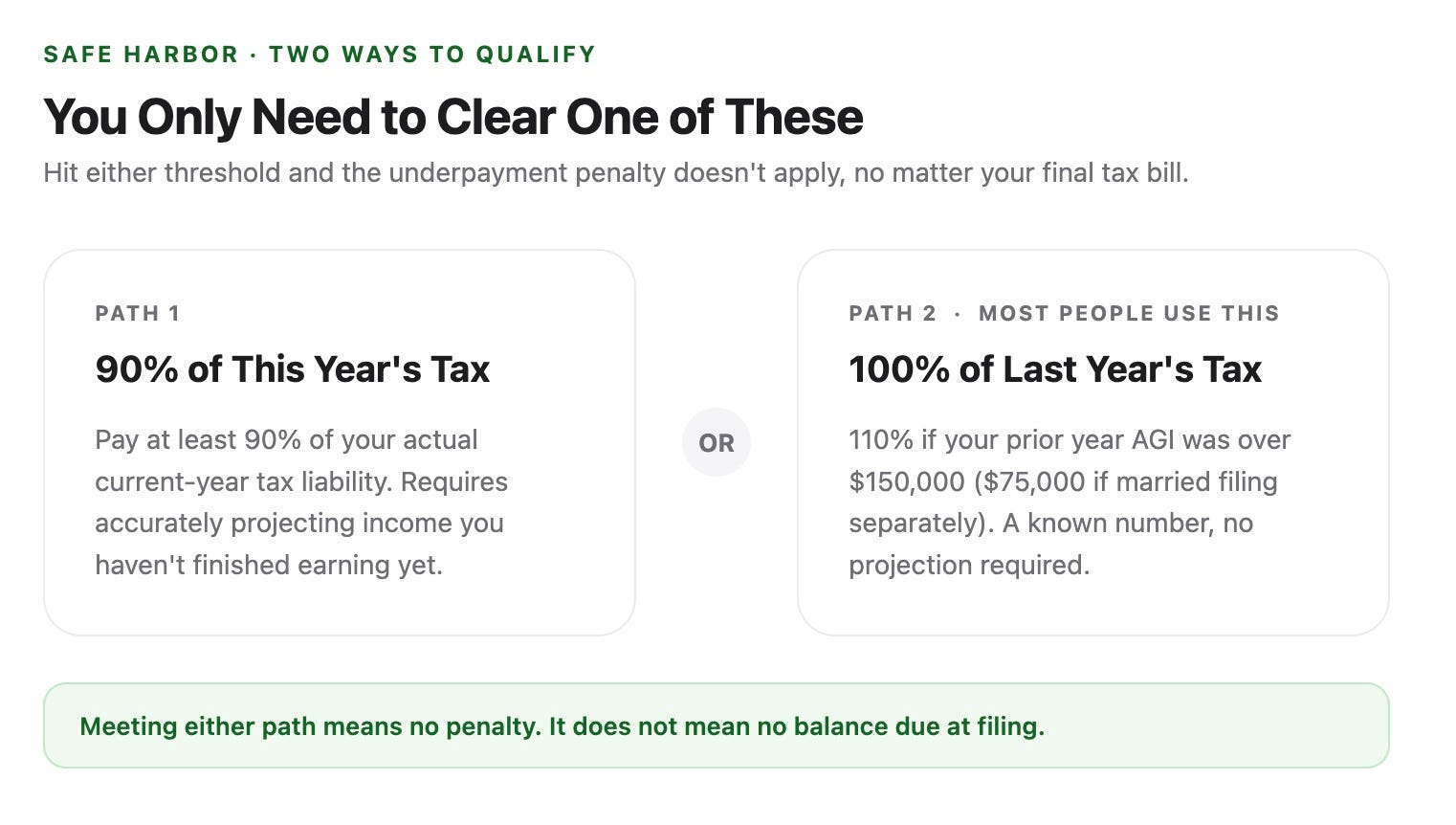
Most people should build around Path 2. Path 1 requires you to accurately project income you haven’t finished earning yet, which is nearly impossible if your income is variable. Path 2 is a known number. It’s whatever you actually paid last year. No projection required.
The Threshold That Catches People Off Guard
Here’s where it gets expensive to misunderstand. If your prior year’s AGI was over $150,000, the bar isn’t 100% of last year’s tax anymore. It’s 110%, and it’s easy to miss if you’re just eyeballing last year’s number instead of checking the actual threshold.
A real example: say your prior year’s tax was $80,000, and your prior year’s AGI was $200,000, which is over the $150,000 threshold. Safe harbor now requires 110% of that $80,000, which is $88,000 total, paid across withholding plus estimated payments combined. Not $80,000. The extra $8,000 matters.
One Important Exception
If your total underpayment at filing is under $1,000 after withholding and credits, no penalty applies at all, regardless of any percentage threshold. This is the de minimis exception, and it’s a nice backstop for people who land close but not perfectly on target.
What Safe Harbor Doesn’t Do
Meeting safe harbor does not mean you owe nothing at filing. It means no penalty. If your actual tax bill is higher than what safe harbor required you to pay, you still owe that difference in April. It’s simply penalty free.
This is the part people get wrong most often. My friend’s business had a genuinely strong year, so she’s still going to owe real money when she files. Safe harbor doesn’t erase that. It just means the IRS can’t charge her interest for underpaying along the way.
What the Penalty Actually Costs
The penalty itself isn’t a flat fee. It’s calculated as interest, quarterly, at the federal short-term rate plus 3 percentage points. For Q3 2026 (July through September), that rate is 7% annualized.
A $10,000 shortfall carried for one quarter at that rate costs roughly $173 in penalty interest. That sounds small in isolation, but it compounds and accumulates across every quarter you’re short, which is exactly why catching this now matters more than trying to fix it in April.
The Fix Most People Don’t Know About
Here’s the mechanic that actually could get someone out of a jam: withholding is treated as paid evenly throughout the year, no matter when it’s actually withheld. Estimated payments don’t get that treatment. They’re only credited on the date you actually pay them.
That means a withholding increase in November or December, whether it comes from a paycheck adjustment, a bonus, or even an IRA distribution, can retroactively cover a Q1, Q2, or Q3 shortfall. Estimated payments can’t reach back in time like that. Withholding can.
If you or someone you know missed or underpaid an earlier quarter, increasing withholding late in the year is often a cleaner fix than sending an even larger Q4 estimated payment. It can clean up the entire year’s safe harbor calculation retroactively.
How to Actually Check Yourself Today
Pull your prior year’s total tax and AGI from your return.
Determine whether the 110% threshold applies to you.
Add up this year’s withholding plus estimated payments made so far.
If you’re short, this is the moment to fix it, whether through a Q3 payment or an adjustment to withholding before year end.
This isn’t a once a year decision. It’s worth revisiting each quarter, especially in a year where income moved around more than expected.
The Bottom Line
Safe harbor is one of the most protective, most underused rules in the tax code, and it only works if you actually check the numbers before the deadline, not after the penalty notice arrives.
Avoid the penalty by paying 90% of this year’s tax, or 100% of last year’s (110% if your prior year AGI was over $150,000)
Meeting safe harbor doesn’t erase the balance due. It just erases the penalty.
The Q3 2026 penalty rate is 7% annualized, and it compounds every quarter you’re short
Withholding counts as paid evenly all year, which makes it a powerful late-year fix that estimated payments can’t replicate
No penalty applies at all if your total underpayment is under $1,000
This is exactly the kind of thing worth running by a CPA or financial planner, especially if your income moved meaningfully this year or you’re not sure which threshold applies to you. It’s a five-minute conversation that can save you months of accumulated interest.
See you next week.
— Fran


Whenever you’re ready, there are 2 other ways we can help you:
Join The Opulus Method Newsletter — Every Tuesday, I share strategies that help high-income millennials build wealth without sacrificing their life. Join 3,200+ readers.
Work With Us 1-on-1 — We’ll build your personalized strategy to cut your taxes, maximize your income, and grow your wealth month after month. You focus on living your life. We handle the financial strategy and execution.
Opulus, LLC (“Opulus”) is a registered investment advisor in Pennsylvania and other jurisdictions where exempted. Registration as an investment advisor does not imply any specific level of skill or training.
The content of this newsletter is for informational purposes only and does not constitute financial, tax, legal, or accounting advice. It is not an offer or solicitation to buy or sell any securities or investments, nor does it endorse any specific company, security, or investment strategy. Readers should not rely on this content as the sole basis for any investment or financial decisions.
Past performance is not indicative of future results. Investing involves risks, including the potential loss of principal. There is no guarantee that any investment strategies discussed will result in profits or avoid losses.
All information is provided “as-is” without any warranties, express or implied. Opulus does not warrant the accuracy, completeness, or reliability of the information presented. Opinions expressed are those of the authors, Ryan Greiser and Francis Walsh, and are subject to change without notice.
Opulus is not responsible for any errors or omissions, nor for any direct, indirect, or consequential damages resulting from the use or reliance on this information. Use of the content is at your own risk. This content is not intended as an offer or solicitation in any jurisdiction where such an offer or solicitation would be illegal.