


Every single week, we have a conversation with someone that goes something like this:
“My RSUs just vested. Should I hold them? The stock’s been going up.”
And then, almost as an afterthought:
“Also, my accountant says I owe $11,000. How is that possible if they already took taxes out?”
Two questions, and they almost always come together. RSUs have become one of the most common reasons people reach out to us. And as more companies pay people in equity, more people are running into the same issues.
Here’s the problem: most people treat every vest as a one-off decision. They hold by default, hope the stock keeps going up, and figure out the taxes in April.
That’s how you end up with too much of your net worth in one company and a tax bill you didn’t plan for.
Let’s dig in ↓
Treat Your RSUs Like a Cash Bonus
Once RSUs vest, they’re income. They’re taxed as ordinary income just like your salary, and they show up on your W-2.
So here’s the question we ask every client:
If your company handed you a $50,000 cash bonus today, would you use all of it to buy company stock?
Almost nobody says yes. But that’s exactly what you’re doing when you hold vested RSUs. You’re just doing it by default.
And here’s what most people don’t realize: because you already paid income tax on the full value at vest, your cost basis is the vest price. If you sell right away, there’s little to no additional tax.
There’s no tax benefit to holding newly vested shares. Holding is purely an investment decision - and one most people never actually make on purpose.
That’s why our starting point is to treat RSUs like a cash bonus and sell at vest. You can keep some. You should just have a reason for it.
The 22% Withholding Problem
This is the conversation we have more than any other.
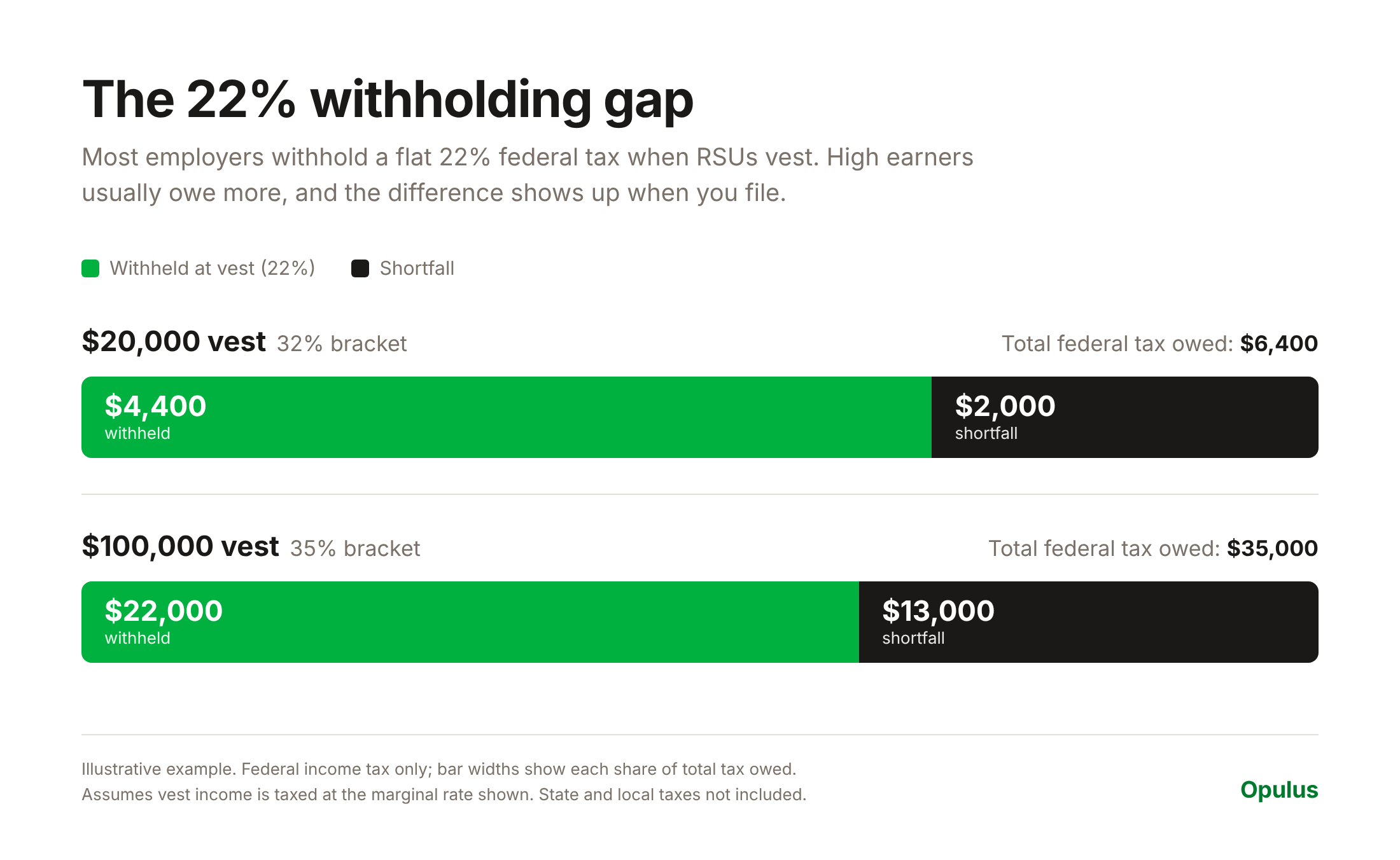
When RSUs vest, most employers withhold federal taxes at a flat 22% (37% on supplemental wages over $1 million in a year). That rate has nothing to do with your actual tax bracket.
If you’re a high earner, you very well could be in the 32% or 35% bracket.
The math:
$20,000 of RSUs vest
22% withheld: $4,400
32% actually owed: $6,400
Shortfall: $2,000
Now scale that up. $100,000 vesting for someone in the 35% bracket = $22,000 withheld vs. $35,000 owed. That’s a $13,000 gap, every year.
Most people don’t find out until they file. We recently met with someone facing a roughly $90,000 tax bill because nobody had looked at withholding across years of vests.
Sometimes state or local over-withholding offsets part of it. But the timing rarely lines up, so don’t count on it.
How to fix it:
Increase your withholding election on vests (if your plan allows) or adjust your W-4
Sell extra shares and set the difference aside in a separate tax account
Make quarterly estimated payments
The best time to deal with this is January, before your first vest. Not April.
How Much Company Stock Is Too Much?
A rule of thumb many financial planners use: no more than about 10% of your net worth in a single stock.
With RSUs, the risk is bigger than it looks, because your paycheck already depends on the same company.
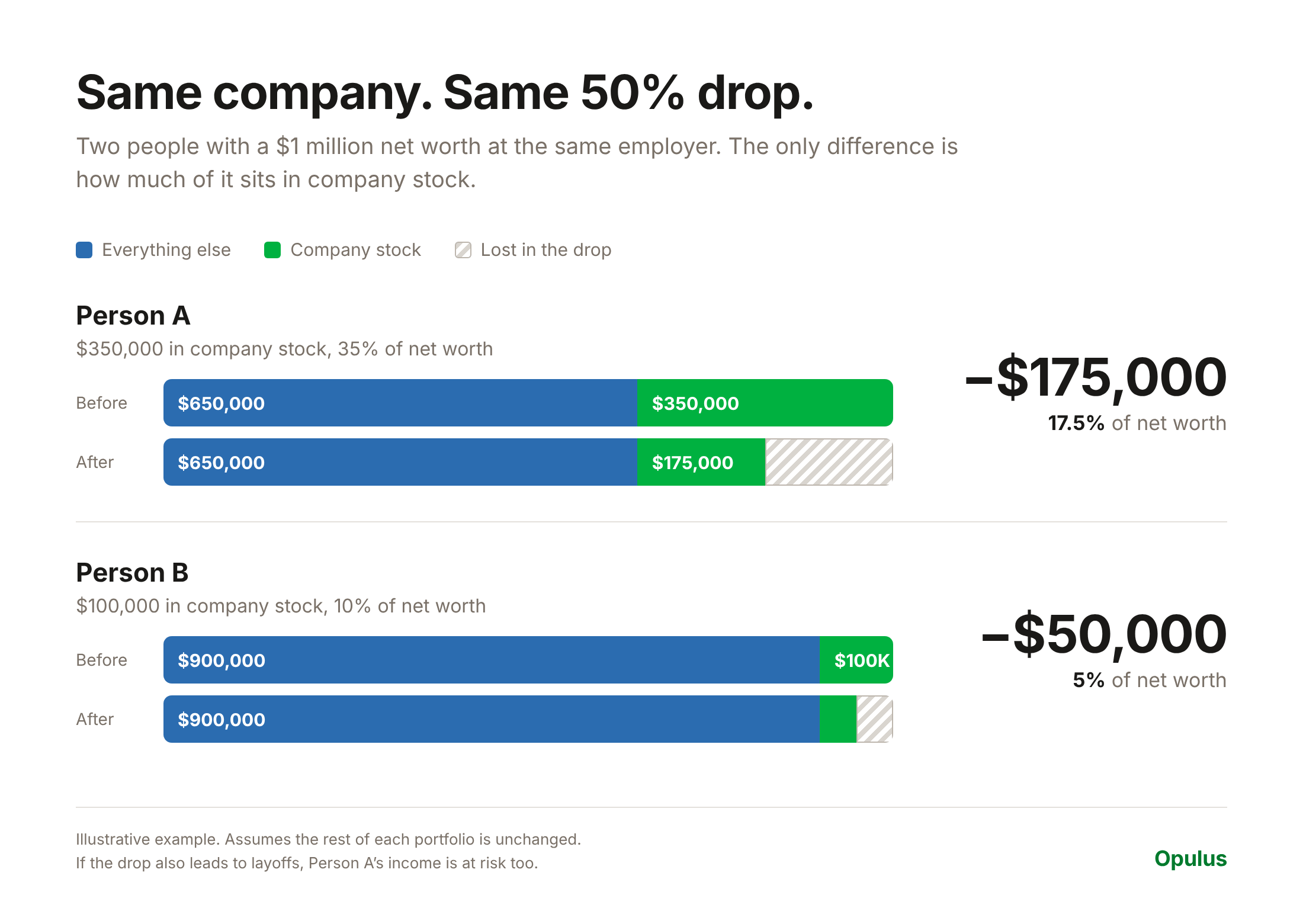
Real scenario: Person A and Person B both have a $1 million net worth and work at the same company.
Person A holds $350,000 in company stock - 35% of their net worth
Person B has diversified down to $100,000 - 10% of their net worth
The stock drops 50%.
Person A loses $175,000 - 17.5% of their net worth
Person B loses $50,000 - 5% of their net worth
And when a stock drops 50%, there’s a real chance layoffs follow. Person A could take a major hit to their net worth and lose their income at the same time.
One client put it well: she didn’t want to put all her faith in the company she was already putting everything else into.
A simple test: if this position went to zero tomorrow, would the rest of your assets still support your goals? If not, you’re too concentrated.
Diversify Over Time, Not All at Once
If you’ve been holding for years, you likely have large gains built up. Selling everything at once could mean a big tax bill. The good news is you don’t have to.
A better approach is a multi-year plan built around a capital gains budget. Decide how much in gains you’re comfortable realizing each year and sell up to that number.
A few strategies worth discussing with your CPA or financial planner:
Sell your highest-basis, long-term lots first. This keeps the tax on each dollar you diversify as low as possible.
Use your losses. Apply any carryforward losses first, then look at harvesting lots that are underwater - shares that vested near a high often are.
Watch the brackets. If a sale would push you into a higher capital gains bracket, splitting it between December and January can help.
Plan around your income. A break, job change, or early retirement year can be a great time to realize gains.
One word of caution: don’t let taxes drive the entire decision. Paying 15% in capital gains tax on your gain is painful. Watching the whole position drop 50% is much worse. Holding a risky stock just to avoid a tax bill is one of the most common and expensive mistakes we see.
The Fear of Selling Too Early
For most people, the biggest obstacle isn’t taxes. It’s regret.
“What if I sell it all and then it goes up 30%?”
That’s a fair concern. So let’s run both scenarios on a $200,000 position where you sell half:
The stock goes up 30%: Holding everything = $260,000. Selling half = $230,000. You “missed” $30,000.
The stock drops 50%: Holding everything = $100,000. Selling half = $150,000. You protected $50,000.
Neither is the perfect outcome. But selling half protects you either way, and you don’t need to predict where the stock goes next.
The other side of this is hesitation after a dip. Selling when the stock is down feels like locking in a loss. I understand that. But the question is the same: if you had the cash today, would you buy this stock at this price? If not, holding it is essentially the same as buying it.
What to Do With the Proceeds
Treat it like any windfall - foundation first:
Pay off high-interest debt. Credit cards at 20-25% come before almost anything else.
Top off your emergency fund.
Increase your retirement contributions. Selling at vest frees up cash flow, so you can max out your 401(k) and lower your taxable income at the same time.
Decide on lower-rate debt. On paper, investing usually beats paying down a 6-7% loan. A middle-ground approach is fine if flexibility matters to you.
Invest the rest in a diversified portfolio. Lump sum or spread out over a few months - pick the one you’ll stick with.
Create a Process and Repeat It
The key is to stop treating every vest as a new decision. Set up a process once and repeat it - Here’s an example:
Step 1: Gather the basics. Your vest schedule, cost basis by lot, and last year’s tax return.
Step 2: Set your target. For example, cap company stock at 10% of your net worth.
Step 3: Sell new vests by default. Anything above your target gets sold when it vests.
Step 4: Fix your withholding in January. Before the first vest of the year.
Step 5: Diversify existing shares on a schedule. Use your annual capital gains budget.
Step 6: Know what happens if you leave. Understand what happens to unvested shares, and watch for awards with short deadlines after you leave - some expire in 90 days.
Step 7: Plan conservatively. Build your plan on your base pay and the shares that have already vested. Treat future grants as upside.
You’ll still be the one clicking “sell” in your stock plan portal. But the decision is already made.
Your Company Isn’t Your Financial Plan
Equity can start to feel like part of your identity. You helped build the company. Selling can feel disloyal, like you’re betting against your own team.
I’ve seen people ride a position from life-changing to disappointing because selling felt like giving up on the company.
You can believe in your company and still sell your vested shares. Those two things aren’t in conflict.
Your job already ties your income to your company. Your investments don’t need to.
Bottom Line
RSUs can be one of the best wealth-building tools you’ll ever get. But only if you’re intentional about them.
That usually means:
Treating vested RSUs like a cash bonus
Fixing the withholding gap before it turns into a tax bill
Keeping any single stock - especially your employer’s - to around 10% of your net worth
Diversifying over time with a capital gains budget
Building a process so every vest isn’t a brand-new decision
Because the goal isn’t to bet on your company. It’s to build wealth that doesn’t depend on it.
See you next week.
— Fran


Whenever you’re ready, there are 2 other ways we can help you:
Join The Opulus Method Newsletter — Every Tuesday, I share strategies that help high-income millennials build wealth without sacrificing their life. Join 3,200+ readers.
Work With Us 1-on-1 — We’ll build your personalized strategy to cut your taxes, maximize your income, and grow your wealth month after month. You focus on living your life. We handle the financial strategy and execution.
Opulus, LLC (“Opulus”) is a registered investment advisor in Pennsylvania and other jurisdictions where exempted. Registration as an investment advisor does not imply any specific level of skill or training.
The content of this newsletter is for informational purposes only and does not constitute financial, tax, legal, or accounting advice. It is not an offer or solicitation to buy or sell any securities or investments, nor does it endorse any specific company, security, or investment strategy. Readers should not rely on this content as the sole basis for any investment or financial decisions.
Past performance is not indicative of future results. Investing involves risks, including the potential loss of principal. There is no guarantee that any investment strategies discussed will result in profits or avoid losses.
All information is provided “as-is” without any warranties, express or implied. Opulus does not warrant the accuracy, completeness, or reliability of the information presented. Opinions expressed are those of the authors, Ryan Greiser and Francis Walsh, and are subject to change without notice.
Opulus is not responsible for any errors or omissions, nor for any direct, indirect, or consequential damages resulting from the use or reliance on this information. Use of the content is at your own risk. This content is not intended as an offer or solicitation in any jurisdiction where such an offer or solicitation would be illegal.