


Maxing out your 401(k) can be the wrong move if you want out before 60.
It’s also the first thing almost every article, coworker, and HR packet tells you to do. That works if you plan to work until 65.
It’s a problem if you don’t.
So you go online to fix it, and the problem only gets worse.
Search “where should I save every dollar” and you’ll get five confident answers that contradict each other. One says go all Roth. Another says take the tax deduction now. A third says skip retirement accounts and invest in real estate, and a fourth says pay off all your debt before investing a single dollar.
Every take sounds smart, but none of them asked what you earn, what tax bracket you’re in, or when you want to step away from your work. So you follow one take for a while, hear a better one, and change course again.
Meanwhile, every dollar you earn lands somewhere, whether you chose it on purpose or not. But if you want financial independence in your 50s or sooner, where your money goes can matter as much as how much you save.
Every account trades a tax break for access
The account with the biggest tax break is usually the hardest one to get your money out of.
Here’s how the three most common accounts compare:
401(k): The biggest tax break, but the money is locked until 59½, with few exceptions.
Roth IRA: Tax-free growth, and what you put in can come out anytime.
Brokerage account: No tax break, and no rules.
“Locked” doesn’t mean you can’t get the money. It means you pay for it if you take it early, and a 401(k) withdrawal before 59½ generally costs you income tax plus a 10% penalty.
Here’s a pattern we see often. A high earner maxes out the 401(k) every year and wants to stop working in their early 50s. They did everything right, and they still can’t touch most of that money without paying a penalty for it.
If you plan to work until 65, that cost rarely matters because you won’t need the money for decades. If you want out earlier, the math changes, because you’ll need money you can reach between your last paycheck and 59½.
That’s why the online advice conflicts. Each person is solving for a different timeline, and almost none of them say which one.
Here’s how I think about solving for where every dollar can go.
Where every dollar can go, in order
Most savings lists are built for retiring at 65, and this one isn’t. Use this order if you want to stop working before the default plan age.
1. Capture the full employer match
The first dollars you save should be the ones your employer will match. Put in enough to get every dollar they offer, because it’s an instant return before the market does anything.
2. Fund the HSA if you’re eligible
An HSA is the rare account with a tax break at every stage. You get a deduction going in, tax-free growth, and tax-free withdrawals for medical costs. You need a high-deductible health plan to qualify.
3. Choose pre-tax or Roth
Some new clients we meet are in the top tax bracket and putting every dollar into Roth.
That can mean paying tax at their highest rate to avoid a lower rate later. The choice comes down to one question: when do you want to pay the tax?
Pre-tax: You skip the tax today and pay it when you take the money out.
Roth: You pay the tax today and skip it when you take the money out.
So pay the tax when your rate is lowest. If your bracket is higher today than it will be later, take the deduction, and if it’s lower today, pay now.
Here’s the catch. Nobody knows what future tax rates will look like, so any answer is an educated guess.
Here’s a starting point, based on your bracket today:
10-12% bracket: Roth. Your rate is low, so you’re paying tax at a bargain.
22-24% bracket: Split. It’s close to a toss-up, so split and revisit each year.
32-37% bracket: Traditional. A deduction is worth the most when your rate is highest.
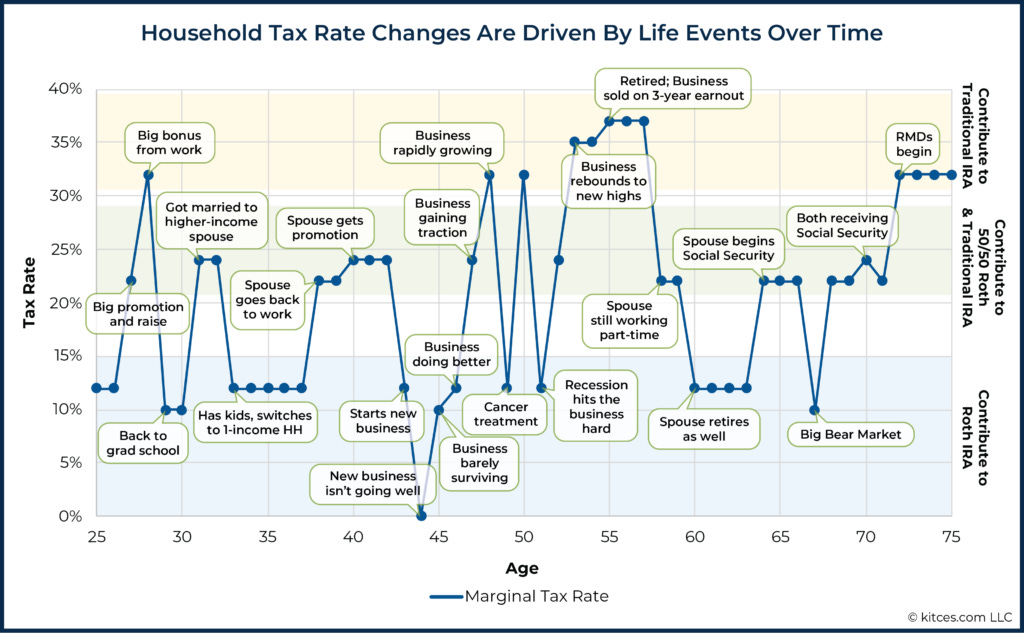
But your bracket doesn’t stay put. It moves with a promotion, a big bonus, a spouse changing jobs, a career break, or a year off.
Michael Kitces has a chart that follows one household’s tax bracket from age 25 to 75, and it swings up and down with life events. His point is that a fixed 50/50 split isn’t a strategy. It’s another default, and he says to match the account to the bracket you’re in that year.
Here’s what that can look like for someone:
Once you’ve picked your split, fill the rest of the plan up to the limit.
The same logic applies to the Roth IRA, but there’s a catch most high earners miss.
4. Roth IRA, and check the income limit first
Many high earners don’t realize their income can lock them out of a Roth IRA.
You can only put money in directly if your income is under a limit, and the amount you’re allowed shrinks as your income climbs through these 2026 ranges:
Single or head of household: $153,000 to $168,000
Married filing jointly: $242,000 to $252,000
Inside your range, you can put in a smaller amount. Above it, you can’t contribute directly at all.
If you’re over, the backdoor Roth is how you still get in: you put money into a traditional IRA, then convert it to Roth. If you already have pre-tax money in an IRA, talk to your advisor first, because it can change how the conversion is taxed.
What you put in directly (not the growth) can come out anytime with no tax or penalty. Backdoor money follows slightly different timing rules, so ask before you count on it.
That’s the Roth IRA, and the next step is where high earners have the most room.
5. Mega backdoor Roth, if your plan allows it
This is the biggest win on the list, and most people never use it.
It lets you take the biggest tax deduction available and still fill a Roth. Your 401(k) has two limits. The first is what you can put in from your paycheck, which is $24,500 in 2026. The second is a bigger cap on everything that goes in from all sources, including your employer and after-tax money, which is $72,000.
Most people stop at the first limit. The mega backdoor uses the room between the two.
Here’s an example for 2026. Your employer’s amount will be different, so treat the $10,000 as a placeholder:
From your paycheck, pre-tax: $24,500. This is the biggest deduction the plan allows.
Match from your employer: $10,000.
Room left under the $72,000 cap: $37,500.
After-tax money you add: $37,500, then convert to Roth.
Once you’ve used the first $24,500, there’s no deduction left to chase. So the extra goes in after-tax and moves to Roth, where it grows tax-free.
Not every plan allows this, so ask HR three questions:
Does the plan allow after-tax contributions beyond the normal limit, and is there a cap?
Can I convert those contributions to Roth inside the plan?
If not, can I move them to a Roth IRA while I’m still employed?
If the answer to the first one is no, you can stop. If it’s yes, you’ve found a lever most people never pull.
Now look at what these five steps have in common: most of the money is tied up until 59½.
Take it out early and you pay for it. If you stop working at 50, that’s nearly a decade of money you can’t touch, and a plan built only from these accounts has a hole in it.
The wild card fills that hole.
6. The wild card: the taxable brokerage account
On a fully optimized plan this account comes last, but in a real life plan it can come first in the order.
That’s why I call it the wild card, because it can go before or after any step on the list. You get no tax break going in and you pay tax on your gains, but you can add money or take it out for any reason, at any time.
It can make sense to give up some tax savings for the freedom to make your plan work and leave room for error. For one person it sits right after the match, and for another it’s dead last.
Move it up when:
You have a target independence date. If you want out before your other accounts open up, this is the bridge that covers those years.
You need access. A house, a business, a career break, or kids can all call for cash you can reach.
You want room for error. I assume my own plan will be wrong somewhere. Life changes, tax law changes, and I’d rather have room to adjust than be stuck defending the original idea.
A big share of your savings is already locked up. At some point, more locks make the plan more fragile, not stronger.
Your income is uncertain. Stock-based pay, a startup, or a sabbatical can make future years hard to predict.
The flexibility will cost you some tax savings. But the more your life can change, the earlier this account belongs on the list.
Start with the order and then place the wild card
Maxing out your 401(k) isn’t the mistake.
Stopping there, with no plan for the years before 59½, is.
The five steps give you an order you can trust, from the employer match through the mega backdoor, and they work for most high earners.
The wild card is the one decision that’s yours.
Place the taxable brokerage account where your timeline, your need for access, and your room for error say it belongs.
Then treat the list as something you revisit and run it again whenever your income, your bracket, or your goal changes. That’s what the answers you found online left out: a framework that holds up, plus one decision you can adjust as life changes.
The next time a confident new take shows up, you won’t need to switch. You’ll know the order, and you’ll know where your wild card goes.
— Ryan


Whenever you’re ready, there are 2 other ways we can help you:
Join The Opulus Method Newsletter — Every Tuesday, I share strategies that help high-income millennials build wealth without sacrificing their life. Join 4,000+ readers.
Work With Us 1-on-1 — We’ll build your personalized strategy to cut your taxes, maximize your income, and grow your wealth month after month. You focus on living your life. We handle the financial strategy and execution.
Opulus, LLC (“Opulus”) is a registered investment advisor in Pennsylvania and other jurisdictions where exempted. Registration as an investment advisor does not imply any specific level of skill or training.
The content of this newsletter is for informational purposes only and does not constitute financial, tax, legal, or accounting advice. It is not an offer or solicitation to buy or sell any securities or investments, nor does it endorse any specific company, security, or investment strategy. Readers should not rely on this content as the sole basis for any investment or financial decisions.
Past performance is not indicative of future results. Investing involves risks, including the potential loss of principal. There is no guarantee that any investment strategies discussed will result in profits or avoid losses.
All information is provided “as-is” without any warranties, express or implied. Opulus does not warrant the accuracy, completeness, or reliability of the information presented. Opinions expressed are those of the authors, Ryan Greiser and Francis Walsh, and are subject to change without notice.
Opulus is not responsible for any errors or omissions, nor for any direct, indirect, or consequential damages resulting from the use or reliance on this information. Use of the content is at your own risk. This content is not intended as an offer or solicitation in any jurisdiction where such an offer or solicitation would be illegal.
Great framework! Charlie Munger estimated that deferring tax, rather than paying it every year, can add 1 to 3 percentage points of annual return, which is part of why tax-advantaged accounts matter. All three account types play a role, and holding a mix gives you flexibility to manage the trade-offs over time.