


A couple I worked with last year came to me with what sounded like a simple question: “When should we claim Social Security?”
They’d already done homework. They’d read that 70 was “optimal.” They’d read that 62 was for suckers who don’t understand compounding. They’d read a dozen confident, contradictory takes - and all of it left them more stuck than when they started.
Here’s what I told them: there isn’t a right age. There’s only the right age for your health, your other assets, and your household’s overall plan. The internet wants to give you a number. Your life is the thing that actually determines the number.
Let’s dig in ↓
Social Security gives you a range, not a rule. You can claim as early as 62. Your Full Retirement Age (FRA) - 67 for anyone born 1960 or later - is where you get 100% of your Primary Insurance Amount. And 70 is the last stop; waiting past it buys you nothing more.
Claim before FRA and your check shrinks permanently. Claim after, and it grows permanently. That’s the entire mechanism. Everything else in this decision is just deciding where between 62 and 70 makes sense for you.
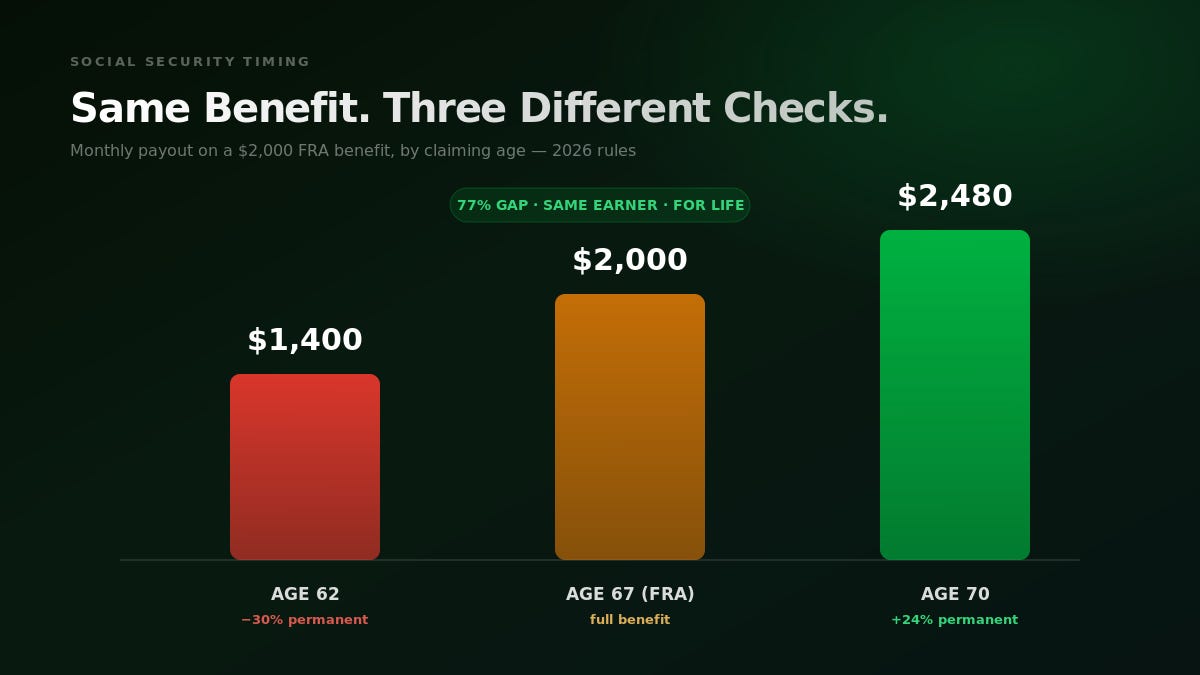
Here’s what that actually looks like in dollars, using 2026 rules and a $2,000/month FRA benefit as the example:
Claim at 62, and you’re locked into roughly $1,400/month for life - a permanent 30% cut.
Claim at 70, and that same benefit grows to roughly $2,480/month - a permanent 24% increase.
Same person. Same earnings record. A 77% gap between the smallest and largest version of that check, paid out every month for the rest of your life. That gap is why this decision deserves more than a gut call.
Why People Reach for a Rule Instead of a Plan
Most people don’t actually disagree about the math. They disagree about which version of themselves they’re planning for.
The case for claiming early usually comes down to reality, not impatience: your other assets are thin, you need the cash flow now, you’re no longer working, or your health and family history suggest a shorter runway. In that situation, a smaller guaranteed check today can beat a bigger uncertain one later.
The case for waiting comes down to a different reality: you have other income - savings, a pension, part-time work - that can bridge the gap. You come from a family that tends to live long. And you’d rather lock in the highest possible income floor than optimize for getting “your money back” as fast as possible.
Neither instinct is wrong. They’re just answers to different balance sheets.
The Breakeven Age Everyone Quotes (and Half-Understands)
If you claim at 62 instead of 70, you collect a smaller check for eight extra years before the larger check would have even started. Add it up, and the two paths cross - the point where the delayed, bigger checks catch up to and pass the early, smaller ones - somewhere around age 80 to 82 for most people.
Live past that age, and delaying paid off. Come in short of it, and claiming early paid off.
The problem is that people treat this single number as the whole analysis. It isn’t. Your family’s longevity and your current health are reasonable inputs into that estimate - not guarantees, and not the only variables that matter. I’ve seen clients anchor so hard on breakeven age that they forget to ask the two questions that usually matter more: what else is funding my life, and who am I leaving behind?
What Else Is Funding Your Life
This is the piece that actually determines whether “waiting” is even realistic for you.
If you’ve got a pension, a brokerage account, or part-time income covering your expenses, delaying becomes far more feasible - you’re not relying on that check to eat, so you can afford to let it grow. But if Social Security is your primary income source, delaying may simply not be realistic. That’s not a planning failure. That’s an honest read of your situation, and claiming earlier can be the correct call.
The Factor Married Couples Almost Always Miss
Here’s the one that changes the entire conversation for couples, and the one my clients hadn’t considered at all.
Delaying doesn’t increase a spousal benefit - it’s capped near 50% of the working spouse’s FRA amount no matter how long that spouse waits. But delaying does increase the survivor benefit. When one spouse passes away, the surviving spouse keeps the higher of the two checks, for the rest of their life.
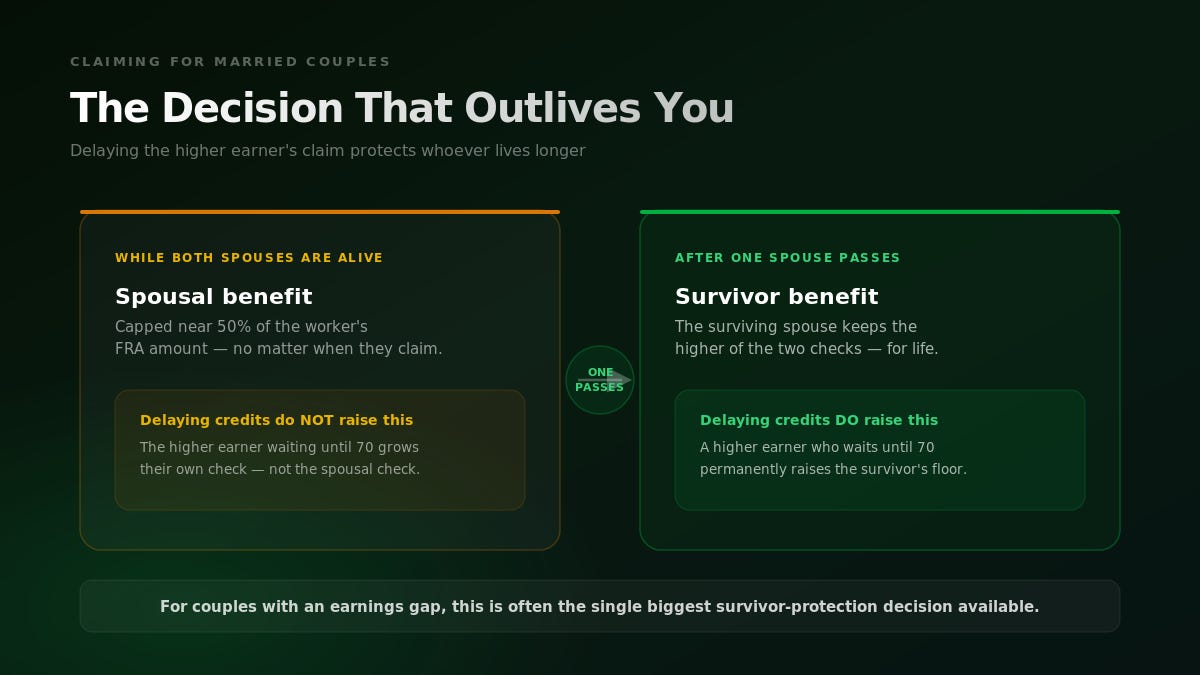
That reframes the whole decision. This stops being about “your” optimal claiming age and becomes about your household’s optimal age. For couples with a meaningful earnings gap, delaying the higher earner’s claim is often the single most consequential decision available for protecting whichever spouse ends up living longer alone.
That’s exactly what shifted things for the couple I mentioned. Once they saw it as a decision that would outlive one of them, “when should I claim” stopped being the right question entirely.
If You’re Still Working
One more wrinkle, and it trips people up more than it should: if you claim before FRA while still working, the earnings test applies. In 2026, the limit is $24,480/year - above that, you lose $1 in benefits for every $2 you earn.
That money isn’t gone. It gets credited back to you later in the form of a higher benefit. But if you’re not expecting the withholding, the short-term cash flow hit can catch you off guard.
How to Actually Run This
Get your FRA benefit estimate. List your other income sources and how long they could bridge a delay. Be honest about your health and your family’s longevity - not optimistic, honest. If you’re married, model the survivor benefit under each claiming scenario, not just your own payout. Revisit the decision every year, because your situation will keep changing until the day you actually file.
No calculator on the internet knows your health, your family’s history, or how you feel about guaranteed income versus market risk. The right age only exists once you plug in your numbers - not the ones in someone else’s thread.
Bottom Line
People want Social Security timing to be a math problem with one clean answer, because clean answers are comforting. It isn’t one. Claiming at 62 locks in a permanent 30% cut versus FRA. Waiting until 70 locks in a permanent 24% increase. The breakeven for most people lands around 80 to 82 - but your health, your other assets, and your marital status can all move that answer around.
If you’re married with an earnings gap, remember that delaying the higher earner’s claim may be the single biggest thing you can do to protect whoever outlives the other.
The goal isn’t to find the age everyone else is using. It’s to find the age that fits the life and the household you actually have.
See you next week.
- Fran


Whenever you’re ready, there are 2 other ways we can help you:
Join The Opulus Method Newsletter — Every Tuesday, I share strategies that help high-income millennials build wealth without sacrificing their life. Join 3,200+ readers.
Work With Us 1-on-1 — We’ll build your personalized strategy to cut your taxes, maximize your income, and grow your wealth month after month. You focus on living your life. We handle the financial strategy and execution.
Opulus, LLC (“Opulus”) is a registered investment advisor in Pennsylvania and other jurisdictions where exempted. Registration as an investment advisor does not imply any specific level of skill or training.
The content of this newsletter is for informational purposes only and does not constitute financial, tax, legal, or accounting advice. It is not an offer or solicitation to buy or sell any securities or investments, nor does it endorse any specific company, security, or investment strategy. Readers should not rely on this content as the sole basis for any investment or financial decisions.
Past performance is not indicative of future results. Investing involves risks, including the potential loss of principal. There is no guarantee that any investment strategies discussed will result in profits or avoid losses.
All information is provided “as-is” without any warranties, express or implied. Opulus does not warrant the accuracy, completeness, or reliability of the information presented. Opinions expressed are those of the authors, Ryan Greiser and Francis Walsh, and are subject to change without notice.
Opulus is not responsible for any errors or omissions, nor for any direct, indirect, or consequential damages resulting from the use or reliance on this information. Use of the content is at your own risk. This content is not intended as an offer or solicitation in any jurisdiction where such an offer or solicitation would be illegal.
This information is invaluable. I have had questions about social security that I never asked. It became buried in the back of my mind after my mother's transition. I was heartbroken when I saw the amount of earnings she had made in her life time. As a Black woman she had to piece together job earnings to raise my sister and me. I did not know the abject poverty she endured until I saw what she was receiving from social security at 80 when she passed.
I looked at my earnings as an educated black woman over the pass 50 years and my earning stability has not been much different from my mother's. I calculated over the years and sèe that my life earnings have been at poverty level if you spread it out over time. I now receive social security but if I needed to live on this income without my husbad's income I would be destitute.
The explanation in this article about how social security works is priceless. I found clarity about a question I never asked because perhaps I didnt know what question to ask nor had the money to pay for guidance from those who might have the answer.
It's true, the challenge in making financial decisions does go beyond the numbers into the human condition of everyday life for many people. Everyday poverty and lack of financial education denies one the presence of mind to ask the right questions.
Thank you Ryan for your grounded considerations in bringing useful information that supports awareness.
It seems there is no one right time but there may be some less ideal times based on your own personal circumstances.