


I see this with almost every high-earning investor who calls me for the first time.
They’ve done everything right. Maxed the 401(k). Opened a taxable brokerage account for what’s left over. Bought a total-market index fund, because that’s what every credible voice tells them to do. Low cost. Diversified. Set it and forget it.
And by every measure, it’s the first right move.
But here’s the pattern I keep running into: the same investor who read enough to land on “just buy the index” stops there. They never ask what happens to that fund once tax season rolls around. They treat the fund as the finish line, not the starting point.
It’s not that the advice is wrong. It’s that it’s incomplete.
Because that index fund sitting in your taxable account can’t do something an individual stock position can. And that one gap is worth more than most people realize.
In a five-year backtest I’ll walk you through, that gap was worth $170,000 on a $1,000,000 account.
Same index. Same market exposure. Just structured differently.
Here’s why that gap exists, and why I think a slice of your taxable account should probably look different than it does right now.
Why “just buy the index” isn’t the whole answer
Here’s what most financial advice gets right: for the vast majority of people, a low-cost index fund is the smartest way to invest. I’m not arguing with that.
But that advice was built for pre-tax returns. It says nothing about what happens after the IRS takes its cut.
Think about what’s actually inside an index fund or ETF. It’s a single security wrapped around hundreds of individual stocks. When you own the fund, you own all of it, or none of it.
If Microsoft is down 8% this quarter but the fund overall is up, you have no way to capture that loss. It’s buried inside the wrapper, invisible, unusable.
That’s fine in a 401(k) or an IRA. Nothing in those accounts is taxable until you withdraw, so there’s no loss to harvest and no reason to care.
But a taxable brokerage account is different. Every dollar you put there already survived your top tax bracket once. Every gain the fund produces gets taxed again. And if you’re a high earner with money in a taxable account, you’re paying the highest rate on the largest number.
The investors I talk to did the hard part. They saved consistently, avoided the expensive mistakes, and got the account funded. But the fund they chose to hold it in was never built to solve for taxes. It was built to track a market.
Those are two different jobs. And only one of them is being done.
What direct indexing actually is
Direct indexing flips the structure.
Instead of owning one fund that tracks the index, you own the individual stocks that make up that index directly, usually 250 to 350 of the largest, most liquid names. You still get the same broad market exposure. But now each stock is its own position, with its own tax lot.
That difference matters more than it sounds like it should.
When the market dips, some individual stocks always fall harder than the index as a whole. In a fund, that loss is trapped.
In a direct index, you can sell that one position, lock in the loss on your tax return, and immediately buy something similar to keep your exposure intact. The index barely notices. But your tax bill does.
This isn’t new. Advisors have run this strategy for ultra-wealthy clients for decades. The problem was always cost.
Buying hundreds of individual stocks used to require $250,000 to $500,000 just to get started, plus someone manually tracking every position. Direct indexing is now available with as little as $2,000, thanks to fractional shares and automated tax-loss harvesting.
There’s a second benefit that has nothing to do with taxes: control. And it shows up in two different ways.
The first is practical. If your company stock or RSUs have run up, you’re probably already overexposed to one name without realizing how much. A direct index lets you exclude that stock entirely, so you get the market exposure you want without doubling down on a position you’re already carrying somewhere else.
The second is personal. A direct index lets you exclude entire industries you don’t want to profit from, for reasons that have nothing to do with performance. I do this with tobacco. It’s cost people close to me their health, and I don’t want my money anywhere near it.
A fund can’t make these exception. A direct index can.
The actual numbers
Here’s what this looks like when you run it through real math.
Altruist ran a five-year backtest comparing two identical $1M portfolios, both tracking the S&P 500 through direct indexing. One was left alone, buy-and-hold, no tax management. The other used daily tax-loss harvesting and tax-aware rebalancing. Same index. Same market. Same five years, January 2020 through May 2025.
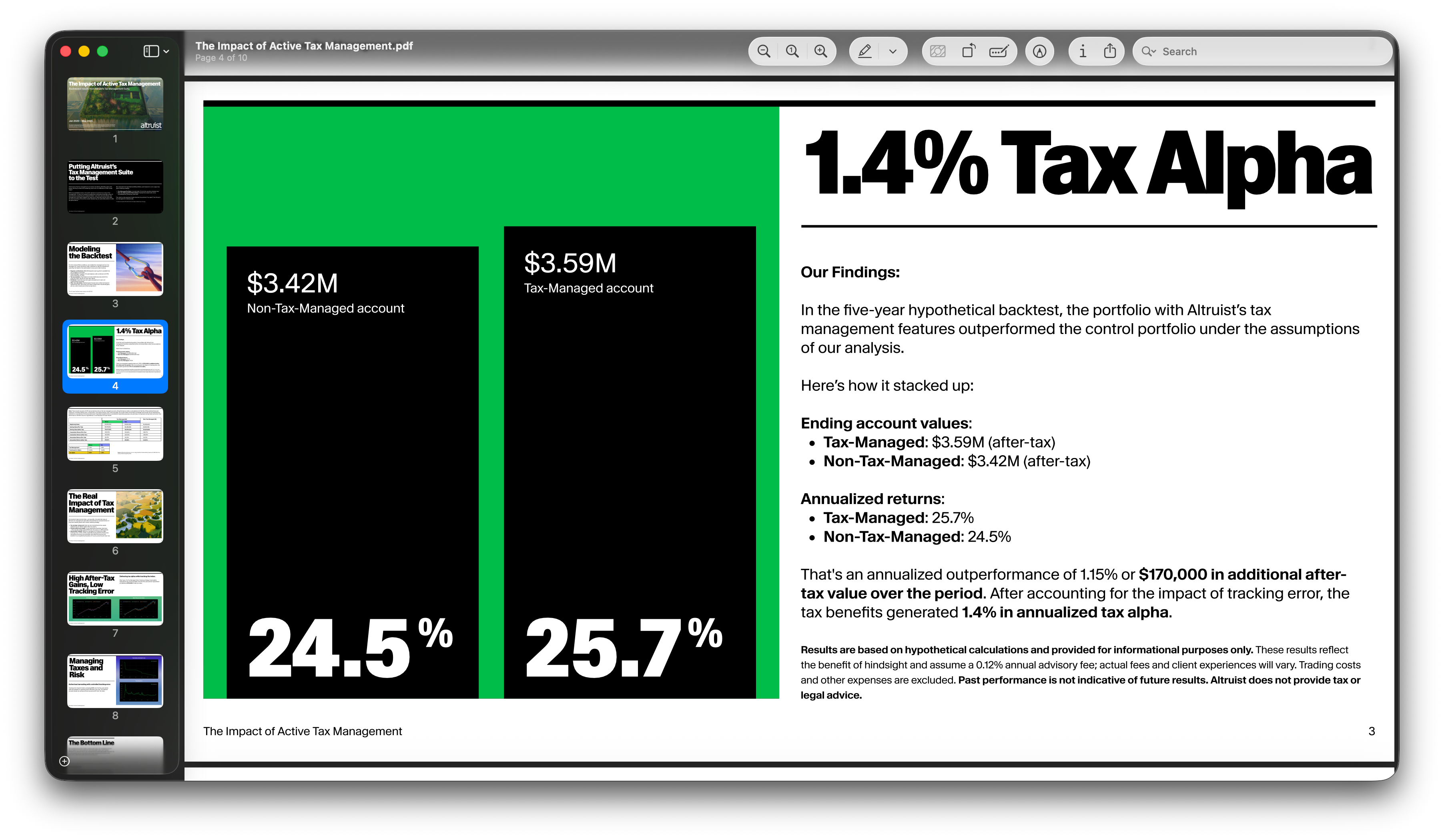
Before taxes, the two portfolios tracked almost identically. That’s the point. Direct indexing isn’t a bet against the market. It’s not trying to beat the index.
After taxes, the story changes.
Tax-managed portfolio: $3.59 million
Untouched portfolio: $3.42 million
That’s $170,000 of additional after-tax wealth, generated from owning the exact same index, structured to work harder on the tax side.
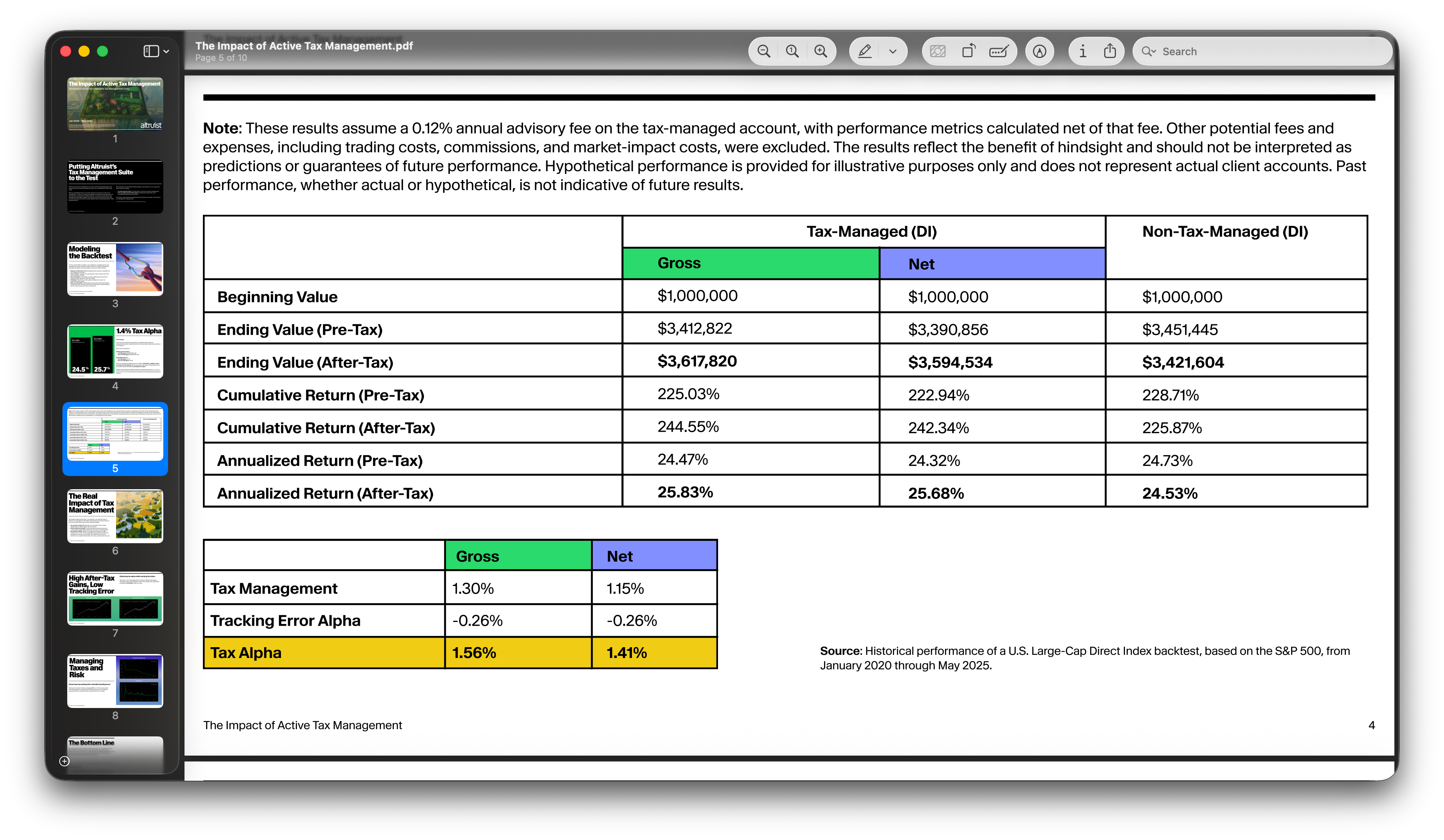
Annualized, that’s roughly 1.4% of tax alpha a year. Not from picking better stocks. Not from timing the market. Just from being able to sell what’s down while holding what’s up, something a single fund can never do.
Now, this kind of active tax management does introduce some tracking error against the index, since you’re occasionally out of a position while it’s replaced. In this backtest, that tracking error averaged about 0.5% over the five years. Small, and clearly outweighed by what it bought.
This is a hypothetical backtest, not actual client results, and Altruist is upfront about that. Markets won’t repeat exactly, and your results will depend on your own account, your own tax situation, and how the market behaves going forward.
But the mechanism is real, and the direction of the outcome is not a coincidence.
Where this actually fits in your plan
The tax-loss harvesting piece specifically lives in a taxable brokerage account.
That’s where every gain and loss actually touches your tax return, and where there’s something worth harvesting in the first place. Retirement accounts bring their own reasons to consider direct indexing, control and visibility into exactly what you hold, but that’s a different conversation for a different day.
It’s also not meant to replace your entire portfolio. I typically see this work best as a slice, a portion of your taxable account built this way, not the whole thing. You’re not abandoning simplicity. You’re adding a layer to the part of your money that can actually benefit from it.
The people I see get the most out of this tend to fall into two groups.
High earners with concentrated stock, RSUs that have run up, options vesting, or a name that’s become too large a piece of their net worth without them fully realizing it.
Investors who’ve already done the basics well, maxed the accounts, built the index position, and are looking for the next real lever, not another account to open.
What I see with clients who use this well is simple. They’re not trying to outsmart the market. They’re just making sure the account doing the least amount of tax-favorable lifting gets a little more attention.
That’s the whole shift. Not a different strategy. The same strategy, built to actually benefit from what’s happening underneath it.
That’s it.
I still think about that investors who calls me for the first time, index fund already in place, doing everything the internet told them to do.
I’m not trying to talk them out of it. I just don’t stop where they stopped.
The tobacco exclusion for me isn’t really about tobacco. It’s the same principle as the tax-loss harvesting: once you’re inside the index instead of standing outside it looking at one fund, you get to make decisions the fund was never built to let you make.
Most people think of their taxable account as the leftover bucket, whatever’s left after the retirement accounts are maxed. It doesn’t have to work that way. It can be the account that’s most tuned to exactly what you hold, what you’ve already got too much of, and what you never wanted to own in the first place.
Same market and same index. Just paying closer attention to what’s actually inside it.
— Ryan


Whenever you’re ready, there are 2 other ways we can help you:
Join The Opulus Method Newsletter — Every Tuesday, I share strategies that help high-income millennials build wealth without sacrificing their life. Join 4,000+ readers.
Work With Us 1-on-1 — We’ll build your personalized strategy to cut your taxes, maximize your income, and grow your wealth month after month. You focus on living your life. We handle the financial strategy and execution.
Opulus, LLC (“Opulus”) is a registered investment advisor in Pennsylvania and other jurisdictions where exempted. Registration as an investment advisor does not imply any specific level of skill or training.
The content of this newsletter is for informational purposes only and does not constitute financial, tax, legal, or accounting advice. It is not an offer or solicitation to buy or sell any securities or investments, nor does it endorse any specific company, security, or investment strategy. Readers should not rely on this content as the sole basis for any investment or financial decisions.
Past performance is not indicative of future results. Investing involves risks, including the potential loss of principal. There is no guarantee that any investment strategies discussed will result in profits or avoid losses.
All information is provided “as-is” without any warranties, express or implied. Opulus does not warrant the accuracy, completeness, or reliability of the information presented. Opinions expressed are those of the authors, Ryan Greiser and Francis Walsh, and are subject to change without notice.
Opulus is not responsible for any errors or omissions, nor for any direct, indirect, or consequential damages resulting from the use or reliance on this information. Use of the content is at your own risk. This content is not intended as an offer or solicitation in any jurisdiction where such an offer or solicitation would be illegal.