


I get asked this question constantly. By friends, by prospects, by people at a dinner or party who find out what I do for a living and can’t help themselves.
“What’s the best financial decision you’ve ever made?”
I can tell you exactly what they’re hoping I’ll say. A tax strategy nobody else knows about. Some stock I bought before it took off. Some ridiculous crypto gamble that made me look like a genius at exactly the right moment. And look - I’ve got a few fun stories from when I was younger and reckless. Some of them even worked out great (Most went very poorly though for the record)
None of them are close to the real answer.
The best financial decision I’ve ever made was walking away from a “safer” company and starting Opulus with Ryan. Betting on myself instead of following the safer, more structured “traditional” route.
I remember our old boss telling us it was one of the worst idea he’s ever heard and we would never make it, a message I still think about from time to time as a motivator.
But that’s the answer. It’s almost never the one people want to hear.
Let’s get into it ↓
Why Nobody Wants This Answer
People want a tactic. Something they can copy this weekend. A specific fund, a specific move, a specific number.
Starting a business isn’t a tactic. It’s a decision to bet on yourself, with real risk attached, and no guarantee it works. That’s a much harder thing to sell someone at a dinner party than “buy this index fund.”
But here’s what I’ve noticed after years of doing this professionally: the people obsessing over the tactics are almost always the ones who’ve never touched the one lever that actually moves the number.
The Lever Everyone Skips
Walk into almost any conversation about personal finance and it goes the same way. Roth or Traditional? Which index fund has the lowest expense ratio? Should I be in three funds or one? Is my allocation right for my age?
These aren’t bad questions. I answer them every week. But they’re optimizing around the edges of a number that, for most people in their 20s, 30s, and even 40s, is still small. You can optimize a small number as hard as you want and it stays a small number.
Here’s the comparison I wish more people ran before they spent another hour agonizing over expense ratios.
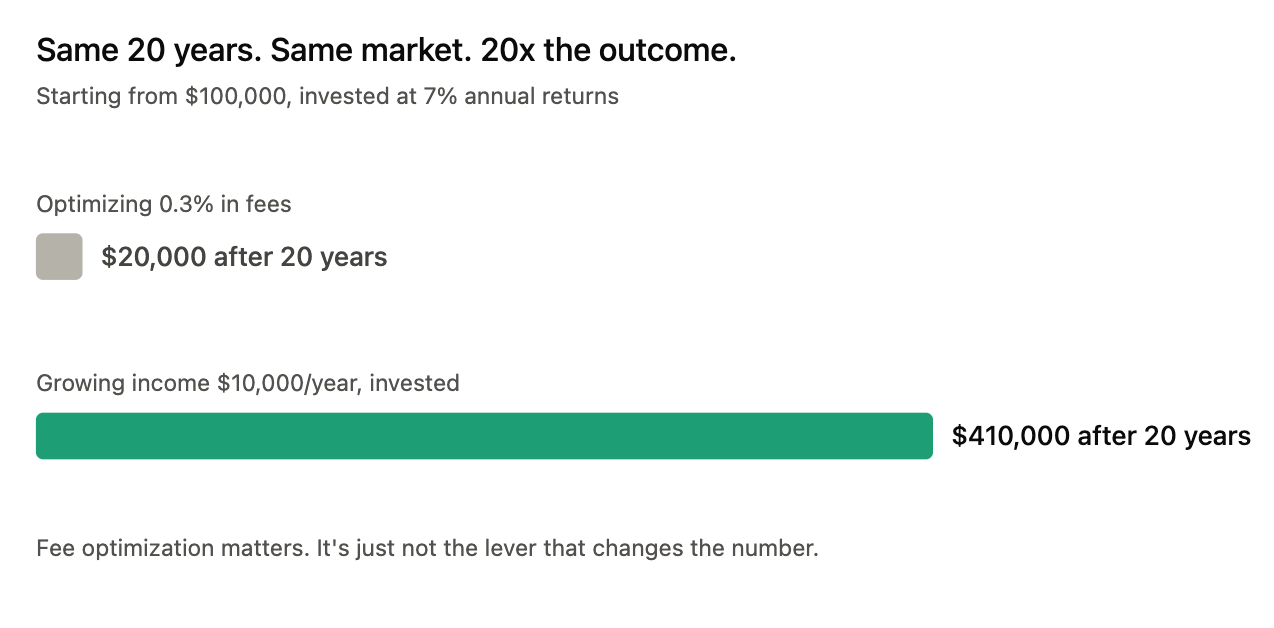
Say you’ve got $100,000 invested, and you spend real time finding a fund that shaves 0.3% off your fees - a legitimately good move, by the way, I’m not knocking it. Over 20 years, that saves you around $20,000.
Now say instead you spend that same energy increasing your income by $10,000 a year - a raise, a better job, a skill that makes you worth more - and you invest that difference every year instead. Over the same 20 years, that’s worth roughly $410,000.
Same time horizon. Same market returns. Twenty times the outcome. And most people spend 10x more mental energy on the first one than the second.
Your Biggest Asset Isn’t in Your Portfolio
There’s a concept called “human capital” - basically the present value of everything you’re going to earn for the rest of your career. If you’re in your 20s, 30s, or even your 40s, this number, not your 401(k), not your brokerage account, is almost certainly your biggest financial asset.
For a lot of younger professionals, the math works out to a present value in the millions - money that doesn’t exist yet, but will, based on your career trajectory. Nobody manages that asset with a spreadsheet. Nobody rebalances it quarterly. Most people never think about it as an asset at all.
I have a vivid memory being 20 years old sitting on a beach with my Uncle Ken, an extremely successful entrepreneur. The words he told me that day have always stuck with me. “You should never let someone else decide how much you can make or how much you can grow. If you’re ambitious, driven, and have control over those two things you’ll always be successful.”
I think that’s the biggest blind spot in personal finance. We spend so much energy managing the money we already have that we ignore the asset that’s actually capable of changing everything - our own earning power.
Starting Opulus was me deciding to actually manage that asset instead of ignoring it.
Why I Bet on It Anyway
It wasn’t a sure thing, and I’m not going to pretend it was. Ryan and I both walked away from something more stable to build something that had a real chance of going nowhere. There were months early on where I wondered if we’d made a huge mistake. I remember staring at CNBC on the tv in Ryan’s basement as the market was down 9.99% in a single day (Covid times) wondering how this could be happening right after we got started in August 2019.
But here’s the way I actually thought about it at the time. If it didn’t work, I’d have taken a financial hit, sure - but I’d still have the skills, the relationships, and the experience to go rebuild an income somewhere else. That downside was survivable. If it did work, though, the ceiling on what I could build for my own family was a completely different number than anything I’d ever earn punching a clock.
The data backs this up more than people realize. Self-employed individuals consistently show up with far higher net worth than employees at similar income levels, and business equity is one of the largest components of wealth for high-net-worth families - second only to home equity. That’s not an accident. It’s what happens when your income is tied to something you can actually grow, instead of a salary someone else caps for you.
This Isn’t “Everyone Should Start a Business”
To be clear, I’m not telling you to quit your job tomorrow. Starting a company is not the right move for most people, and it wasn’t a risk-free decision for me either - I don’t want to romanticize it. It worked out. It doesn’t always. I was 24 years old, no wife, and no kids. Those are real factors many people need to consider that I fortunately wasn’t worried about.
What I am saying is this: the biggest lever in almost anyone’s financial life is their income, and specifically, their ability to grow it, not the 0.2% they’re saving on fund fees or whether they picked Roth over Traditional. That lever looks different for everyone. For me, it was starting a business.
For someone else, it might be a certification that unlocks a promotion, a jump to a company that actually pays for your skill set, or building a side income that eventually outgrows the job.
The version of “betting on yourself” doesn’t have to look like mine. It just has to actually move the number that matters.
How I’d Think About This For Yourself
Before your next hour spent comparing expense ratios or deciding between account types, ask yourself these instead:
What’s the realistic ceiling on my current path, if I do everything right for the next 10 years?
What’s actually capping my income right now - and is it a real constraint, or just the safe, familiar one?
If I put the same energy I spend optimizing my portfolio into growing my income instead, what would that actually be worth over 10 or 20 years?
What’s the version of “betting on myself” that fits my actual risk tolerance - not reckless, but not nothing either?
For most people, the honest answers to those questions matter more than anything a financial advisor can do with their existing portfolio.
Bottom Line
Everyone wants the best financial decision to be a secret. A ticker symbol. A tax loophole. Something you can screenshot and act on by Friday.
Mine wasn’t a secret. It was a decision to stop optimizing around my income and start trying to grow it, even with real risk attached, even with a few sleepless nights along the way. Starting Opulus with Ryan is still, by a wide margin, the best financial decision I’ve ever made - not because it was safe, but because it changed the size of every other number in my financial life.
Optimize your portfolio. Please, do it - it matters, and I’ll keep answering those questions every single week. But don’t mistake fine-tuning what you already have for the thing that actually builds wealth. That’s almost always on the income side, not the allocation side.
See you next week.
— Fran


Whenever you’re ready, there are 2 other ways we can help you:
Join The Opulus Method Newsletter — Every Tuesday, I share strategies that help high-income millennials build wealth without sacrificing their life. Join 3,200+ readers.
Work With Us 1-on-1 — We’ll build your personalized strategy to cut your taxes, maximize your income, and grow your wealth month after month. You focus on living your life. We handle the financial strategy and execution.
Opulus, LLC (“Opulus”) is a registered investment advisor in Pennsylvania and other jurisdictions where exempted. Registration as an investment advisor does not imply any specific level of skill or training.
The content of this newsletter is for informational purposes only and does not constitute financial, tax, legal, or accounting advice. It is not an offer or solicitation to buy or sell any securities or investments, nor does it endorse any specific company, security, or investment strategy. Readers should not rely on this content as the sole basis for any investment or financial decisions.
Past performance is not indicative of future results. Investing involves risks, including the potential loss of principal. There is no guarantee that any investment strategies discussed will result in profits or avoid losses.
All information is provided “as-is” without any warranties, express or implied. Opulus does not warrant the accuracy, completeness, or reliability of the information presented. Opinions expressed are those of the authors, Ryan Greiser and Francis Walsh, and are subject to change without notice.
Opulus is not responsible for any errors or omissions, nor for any direct, indirect, or consequential damages resulting from the use or reliance on this information. Use of the content is at your own risk. This content is not intended as an offer or solicitation in any jurisdiction where such an offer or solicitation would be illegal.