


Social Security went viral again last week.
The argument split almost perfectly by age. One side: “I paid in for 40 years. I was promised this.” The other side: “I’m paying a chunk of every paycheck into a system that won’t pay me back. Let me invest it myself.”
Both sides have a point. And the purpose of today’s newsletter isn’t to pick one.
It's to talk about the part that actually matters for your plan. Today, about half of Americans 65 and older get at least half their income from Social Security. If you're in your 30s or 40s, that can't be your plan.
Let’s dig in ↓
The Numbers Behind the Noise
Here’s where things stand, straight from the 2026 Trustees Report.
The trust fund that pays retirement benefits is projected to run out of reserves in late 2032. That’s six years away.
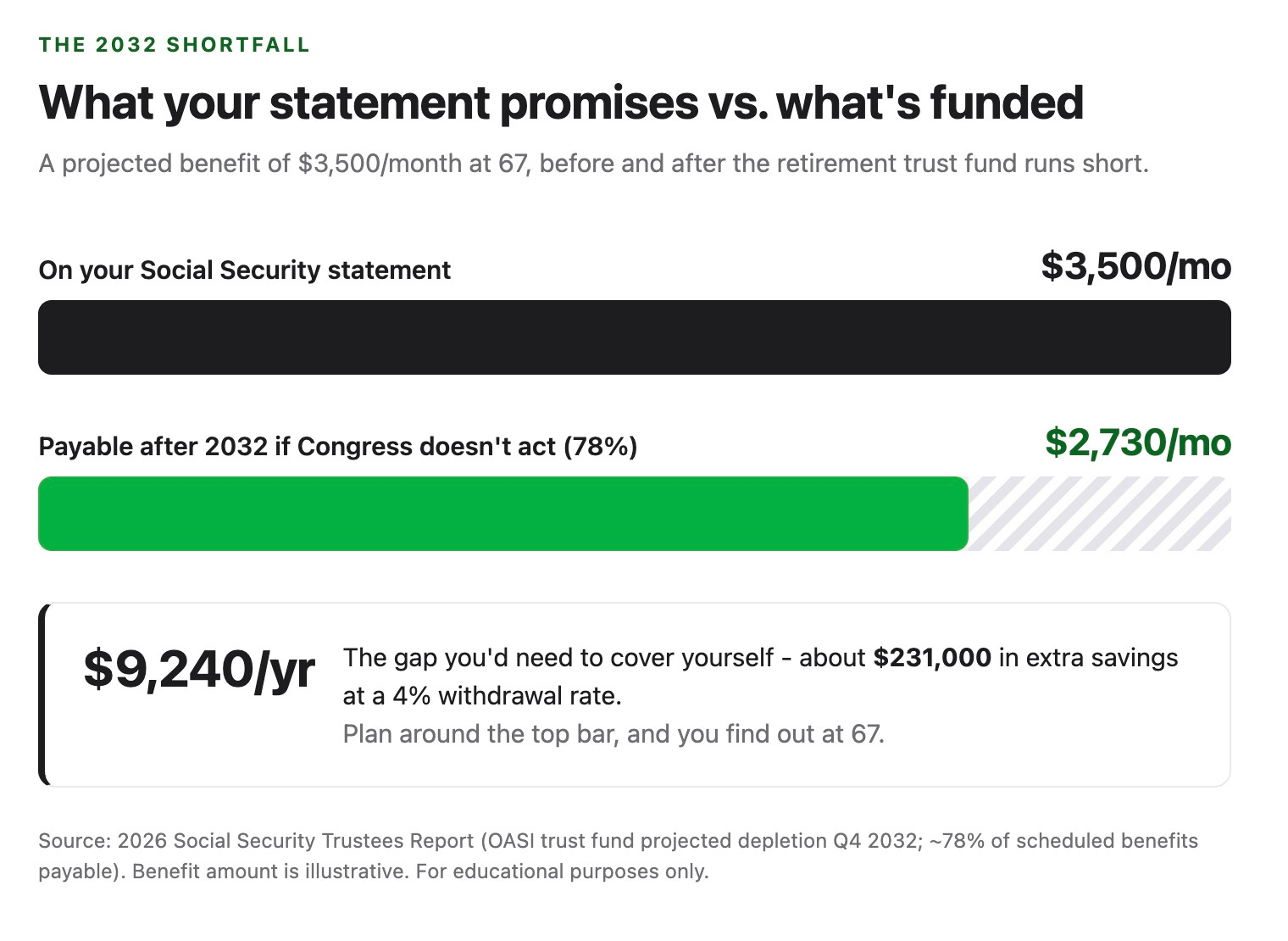
That doesn’t mean checks stop. It means incoming payroll taxes would only cover about 78% of scheduled benefits. Without a fix from Congress, every retiree takes a roughly 22% cut overnight.
Why is this happening? Simple demographics. In 1960, there were about five workers paying in for every retiree. Today it’s under three - and that number keeps falling.
So Social Security isn’t disappearing. But the version you’ve been promised on your annual statement? That’s the version most likely risk.
“Let Me Invest It Myself”
The younger generation’s argument isn’t emotional. It’s totally reasonable based on simple projections.
Every paycheck, you pay 6.2% of your wages into Social Security, on income up to $184,500 in 2026. Your employer matches it, but let’s just look at what comes out of your pocket.
Earn $150,000? That’s $9,300 a year.
Invest $9,300 a year for 40 years at a 7% average return and you’d have roughly $2 million. And unlike a Social Security check, every dollar of it is yours - to spend, invest, or pass on to your kids.
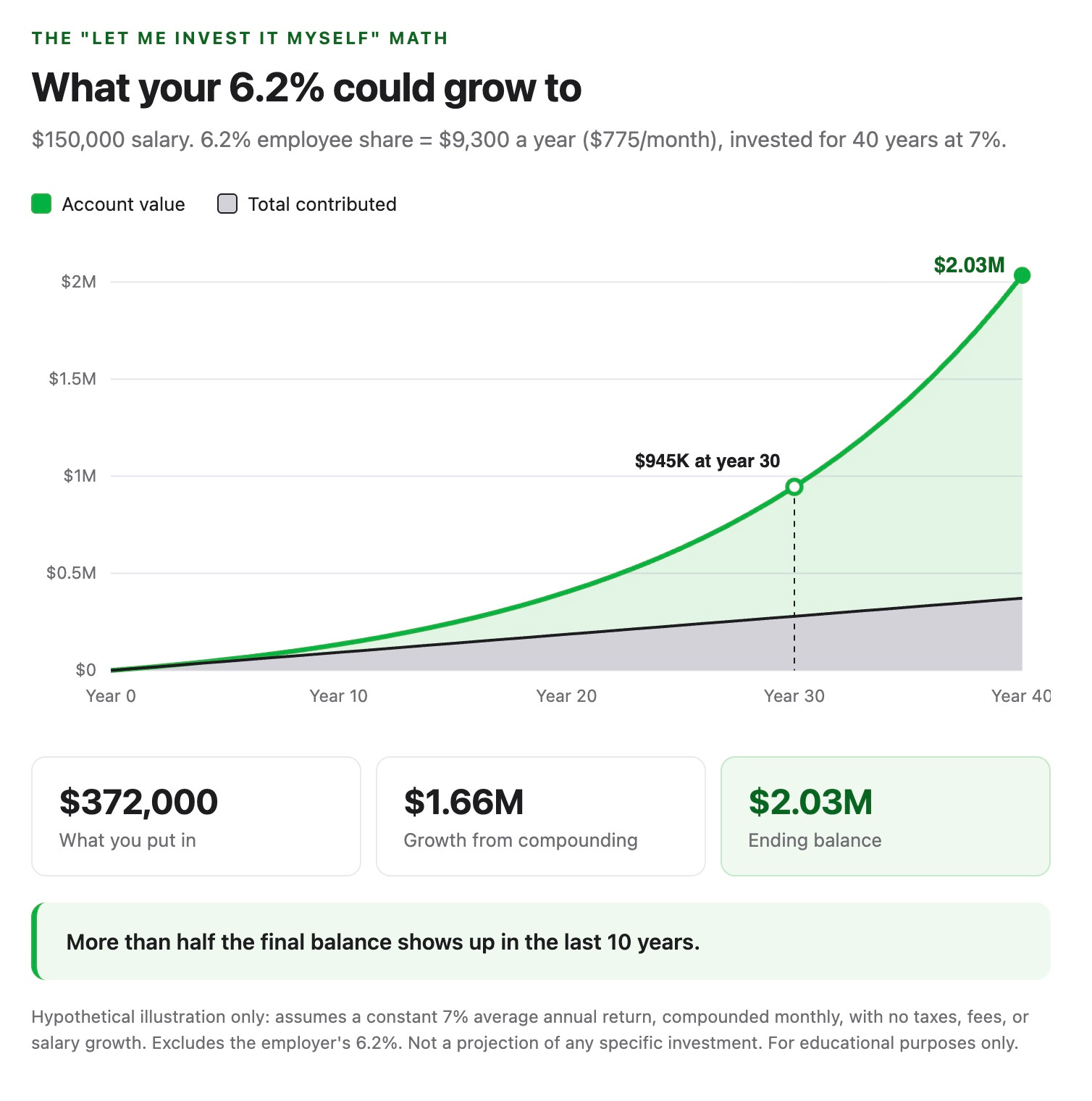
So yes, purely as an investment, the deal looks less than ideal for high earners today.
But It’s Not Just a Retirement Account
Here’s what the viral arguments leave out.
Social Security isn’t only a pension. It’s also disability insurance, life insurance for your spouse and kids, and a lifetime annuity that adjusts for inflation and that you can’t outlive.
If you are buying all of that privately. It isn’t cheap.
I’ve seen what happens when a young family loses a parent. Survivor benefits can be the difference between staying in the house and selling it. In my own families situation this was in fact the case when my father passed away as the sole income earner for our family.
So the honest take: Social Security is a bad investment and a pretty decent insurance policy. Judge it as only one of those and you’ll get the wrong answer.
And either way, it’s not optional. You’re paying in. The real question is how much of your plan you let it carry.
So What to Do? Person A vs. Person B
Lets take two 35-year-olds. Same income. Same projected benefit: $3,500/month at 67, or $42,000 a year.
Person A builds their retirement plan around the full $42,000. It’s on the statement, so it’s in the plan.
Person B plans for $0. They act like the check will never show up, and save to replace it.
Replacing $42,000 a year of income takes about $1.05 million, using a 4% withdrawal rate. Person B gets there by investing roughly $860/month for 30 years at 7%.
That’s a real commitment. It’s money Person B isn’t spending today. But here’s how it plays out at 67:
Benefits come in full: Person A is on plan. Person B has an extra $42,000 a year - more travel, more giving, more help for their kids.
Benefits get cut to 78%: Person A is short $9,240 a year and would have needed about $231,000 more saved. Person B barely notices.
Benefits shrink even further: Person A’s plan breaks. Person B’s plan never depended on it.
Person A finds out which scenario they’re in at 67, with no compounding left to lean on. The options are working longer, spending less, or pulling harder from a portfolio that wasn’t built for it.
Person B wins every scenario. The only question is by how much.
How to Build a Plan That Works Without It
Here’s the good news. Planning for $0 doesn’t need a special Social Security strategy. It needs the same 8 foundational steps we walk every client through. Done right, they build a plan that never needed the check in the first place.
1. Set your goals and build a system. Log in at ssa.gov/myaccount and look at your projected benefit. Then set your retirement goal as if that number were zero. Use 50/20/30 as the framework - 50% essentials, 20% financial goals, 30% lifestyle - and automate it so the plan runs without you.
2. Build a cash reserve. 3-6 months of expenses in a high-yield savings or money market account. In retirement, a cash buffer is what keeps you from selling investments in a down market. It’s the job a lot of people assume Social Security will do.
3. Eliminate bad debt strategically. Avalanche or snowball - pick the one you’ll stick with. Every payment you carry into retirement is income you have to replace. No debt means a smaller number to hit.
4. Invest at least 20% of your after-tax income. This is where Person B’s $860/month comes from. On a $150,000 income, 20% of take-home pay covers it with room to spare. Spread it across 401(k), Roth IRA, HSA, and brokerage. If future benefits get taxed more heavily, tax diversification gives you control.
5. Protection planning. Social Security can include disability and survivor benefits. However if you’re not counting on the retirement check, don’t count on those either. Term life and long-term disability coverage close that gap on your terms.
6. Have a basic estate plan. A will, power of attorney, healthcare proxy, and updated beneficiaries. Social Security survivor benefits follow a formula. Your estate plan follows your wishes.
Master steps 1-6 and you’re ahead of 90% of your peers. Then it’s time to optimize.
7. Pay off your home early (if it fits your plan). A paid-off home is one of the most powerful ways to shrink what retirement costs. Retire without a $2,500/month mortgage and you need $30,000 less income every year. Just don’t sacrifice retirement savings to get there faster.
8. Build wealth while living a great life. This is the payoff of planning for $0. If the full check shows up, it’s not covering bills. It’s funding travel, giving, and the things that matter to you.
Just Don’t Be Dependent
Here’s what I keep coming back to.
My grandparents’ generation could reasonably build retirement around a pension and a Social Security check. That world is gone for most of us. Pensions mostly disappeared first. Now the other “pension” is beginning to fade.
That’s not a reason to panic. It’s a reason to take ownership.
Because the anxiety around Social Security isn’t really about the program. It’s about feeling like your retirement depends on decisions made in Washington that you can’t control.
The fix is building a plan where those decisions don’t decide your future.
The Bottom Line
The retirement trust fund is projected to run short in 2032, with benefits cut to about 78% unless Congress acts
For high earners - Social Security is a weak investment but valuable insurance - it’s worth understanding both sides
Plan for $0 by building the foundation - the 8 steps - while time is on your side
Treat Social Security as a bonus to your plan, not the plan itself
Nobody knows exactly what the fix will look like. Higher taxes, a later retirement age, reduced benefits, or some mix.
You don’t need to predict it. You just need a plan that doesn’t depend on it.
Because the goal isn’t to hope the system holds. It’s to build a retirement that holds either way.
See you next week.
— Fran


Whenever you’re ready, there are 2 other ways we can help you:
Join The Opulus Method Newsletter — Every Tuesday, I share strategies that help high-income millennials build wealth without sacrificing their life. Join 3,200+ readers.
Work With Us 1-on-1 — We’ll build your personalized strategy to cut your taxes, maximize your income, and grow your wealth month after month. You focus on living your life. We handle the financial strategy and execution.
Opulus, LLC (“Opulus”) is a registered investment advisor in Pennsylvania and other jurisdictions where exempted. Registration as an investment advisor does not imply any specific level of skill or training.
The content of this newsletter is for informational purposes only and does not constitute financial, tax, legal, or accounting advice. It is not an offer or solicitation to buy or sell any securities or investments, nor does it endorse any specific company, security, or investment strategy. Readers should not rely on this content as the sole basis for any investment or financial decisions.
Past performance is not indicative of future results. Investing involves risks, including the potential loss of principal. There is no guarantee that any investment strategies discussed will result in profits or avoid losses.
All information is provided “as-is” without any warranties, express or implied. Opulus does not warrant the accuracy, completeness, or reliability of the information presented. Opinions expressed are those of the authors, Ryan Greiser and Francis Walsh, and are subject to change without notice.
Opulus is not responsible for any errors or omissions, nor for any direct, indirect, or consequential damages resulting from the use or reliance on this information. Use of the content is at your own risk. This content is not intended as an offer or solicitation in any jurisdiction where such an offer or solicitation would be illegal.
Don’t rely on the kindness of strangers. Consider the government a stranger. You won’t go far wrong with that in mind.