


A friend of mine is closing on a $500,000 house next month, and he asked me what felt like a simple question: “Should I just do the 15-year mortgage so I’m not paying interest forever?”
He wanted a clean answer. Fifteen or thirty. Pick one.
So I actually ran the numbers. Not once. Three separate ways, using three different but completely reasonable sets of assumptions. And the “right” answer flipped every single time.
That’s not me being indecisive. That’s the actual “math”.
Let’s dig in ↓
The Setup: Same Loan, Two Strategies
To make this concrete, picture two people buying the identical $500,000 house on the same day.
Person A takes the 15-year mortgage. Higher monthly payment, house paid off in 15 years. Once it’s paid off, Person A takes that entire freed-up payment and invests it every month for the remaining 15 years.
Person B takes the 30-year mortgage. Lower monthly payment, and invests the difference between the two payments every single month for all 30 years.
Same house. Same purchase price. Same 30-year time horizon. The only variable is how the monthly cash flow gets split between the mortgage and the market.
Scenario 1: Same Rate, Optimistic Returns
First pass: assume both loans carry the identical 6.75% rate, and the market returns 10% annually, which is roughly the long-term historical average for stocks.
The 30-year comes out to $3,243/month, with $667,477 in total interest paid over the life of the loan.
The 15-year comes out to $4,425/month, with $296,419 in total interest.
The gap between the two payments is $1,182/month. That’s what Person B has available to invest every month for 30 years.
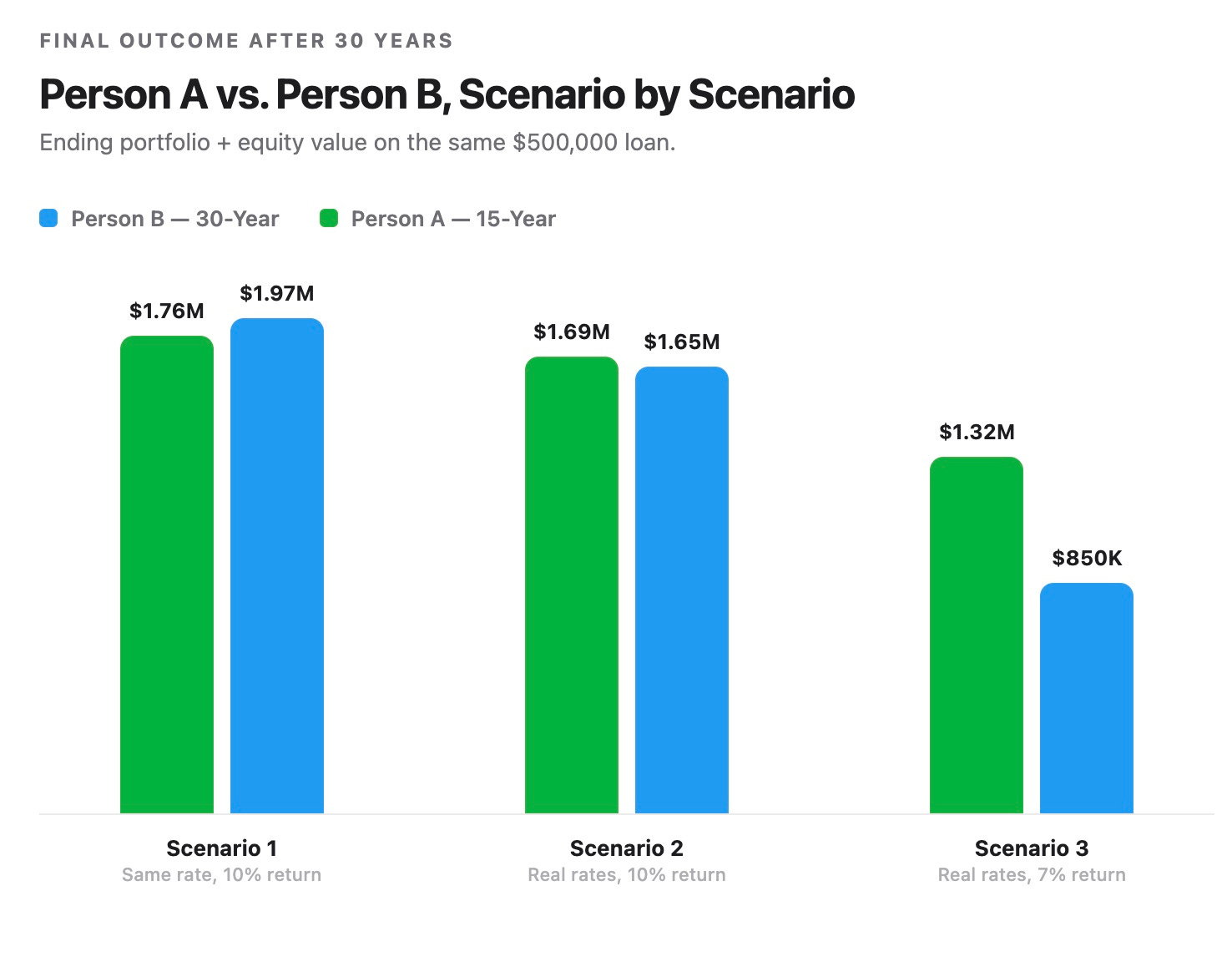
Run it forward: Person A ends up with $1,762,934. Person B ends up with $1,966,582.
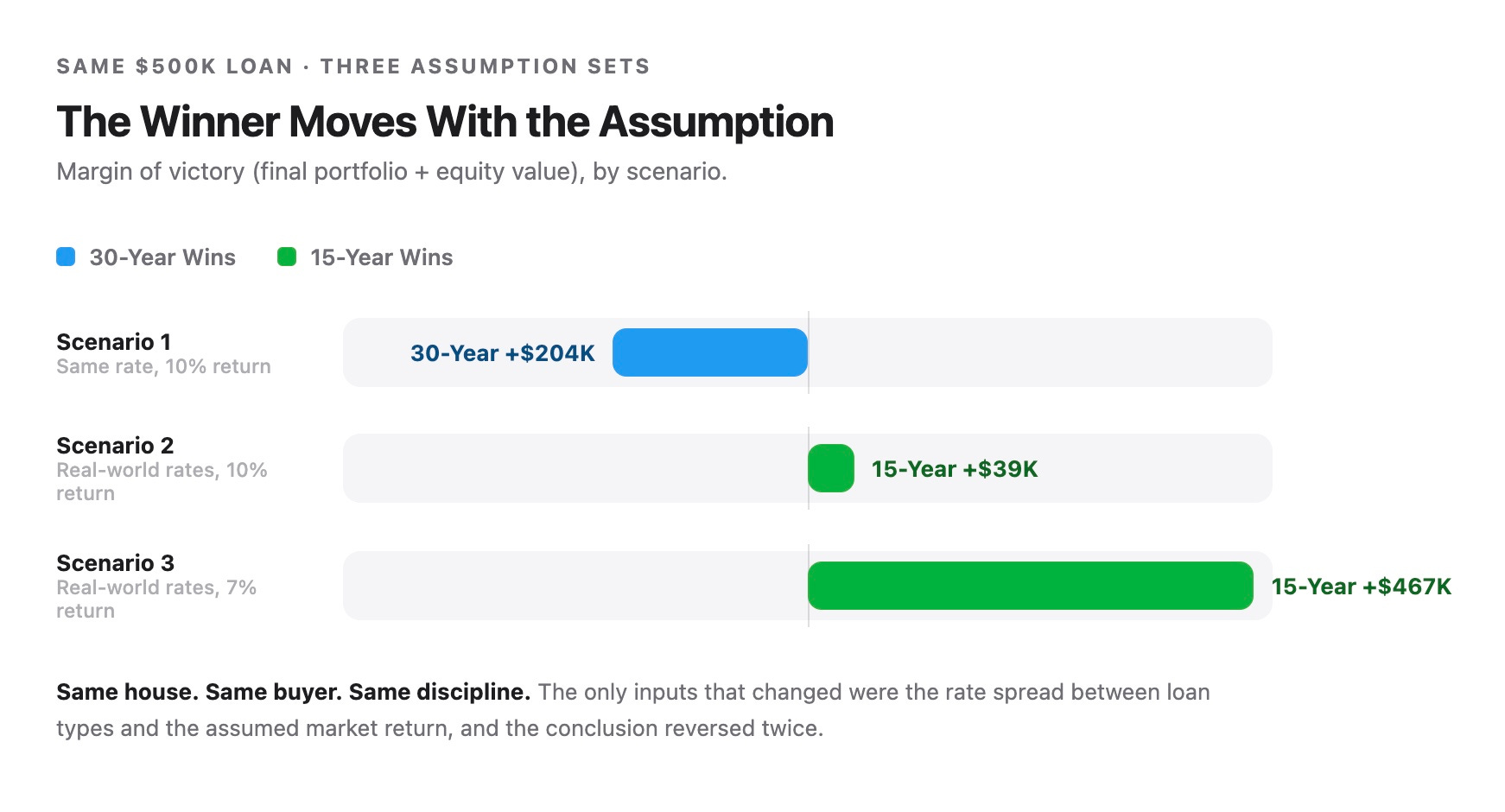
The 30-year wins by $204,000.
This makes intuitive sense. Person B is investing a smaller amount, but for the full 30 years instead of only the back half, and 10% annual growth compounding for three decades is a powerful force. Time in the market beat the extra interest paid.
Scenario 2: What Rates Actually Look Like
Here’s the problem with Scenario 1. It assumes both mortgages carry the same rate, and they don’t. In the real world, 15-year mortgages consistently carry lower rates than 30-year ones, often by half a point or more.
Lenders take on less risk with a shorter loan. Less time for something to go wrong means a better rate for you.
So the more realistic version: 30-year at 6.75%, same as before, $3,243/month and $667,477 in interest. But the 15-year comes in at 6.05%, dropping the payment to $4,233/month and the total interest to $261,904.
Notice what happened to the monthly gap. It shrank from $1,182 to $990/month, because the lower 15-year rate closed part of the distance between the two payments.
Same 10% return assumption. Run it forward: Person A ends up with $1,686,535. Person B ends up with $1,647,443.
The 15-year wins by $39,000.
One change, real-world rates instead of matched rates, and the winner flipped. Not by a landslide, but it flipped.
Scenario 3: A More Conservative Return
Now keep the real-world rates from Scenario 2, but swap the 10% return assumption for a more conservative 7%, which is closer to what many planners use for long-term projections after accounting for inflation and sequence of market cycles.
Person A ends up with $1,316,845. Person B ends up with $849,603.
The 15-year wins by $467,000.
This is the scenario that should get your attention. Person B’s entire strategy depends on decades of compounding a relatively small monthly amount. Drop the assumed return by three points, and that compounding engine loses most of its horsepower. Person A’s advantage isn’t tied to market performance at all. It’s forced equity in a house that’s paid off regardless of what stocks do.
Why the Winner Keeps Moving
Three scenarios. Three outcomes, ranging from a $204,000 win for the 30-year to a $467,000 win for the 15-year. Same house, same buyer, same discipline both times.
The only things that changed were the rate spread between the two loan types and the assumed market return. Nudge either one, and the entire conclusion reverses.
This is the part that matters more than any single number in these scenarios: you can build a spreadsheet that makes almost any decision “win” on paper. Change the rate assumption, change the return assumption, change the time horizon, and the winner moves with it. Nobody knows what the market actually does over the next 30 years. Nobody knows where rates go from here, or what refinancing opportunities show up along the way.
Anyone telling you the 15-year or the 30-year is obviously, always the better choice is selling you a projection dressed up as a fact.
The Trade-off the Spreadsheet Never Shows You
Here’s what none of these three scenarios capture: whether Person B actually invests that monthly difference.
In the math, Person B is disciplined every single month for 30 years, without fail. In real life, that $990 or $1,182/month “extra” tends to get absorbed. A nicer car. A larger vacation. Lifestyle creep that happens so gradually nobody notices it happening.
We see this constantly. The 30-year mortgage only wins in practice if the freed-up cash actually makes it into a brokerage account instead of a bigger everyday life. The 15-year removes that variable entirely. The extra $1,000 or so a month never touches your checking account. It goes straight into home equity, whether you were feeling disciplined that month or not.
That’s the real trade-off. The 15-year forces equity and caps your risk, including the risk you pose to yourself. The 30-year keeps you liquid and gives compounding more room to work, but only if you treat that monthly gap as untouchable.
There’s also a flexibility dimension. The higher 15-year payment leaves less room to breathe if income drops, a job changes, or an emergency shows up. The 30-year payment is easier to carry through a rough stretch, and you can always pay it down faster voluntarily when things are good. You can’t easily go the other direction and lower a 15-year payment when you need the cash flow back.
How to Actually Decide
Skip the generic advice and run this against your own numbers:
Get real, current quotes for both terms from your actual lender. Don’t assume a rate spread. It varies by lender, by credit profile, and by market conditions at the time you lock.
Be honest about whether you will actually invest the difference every month, automatically, without fail. If the answer is “probably not,” the theoretical 30-year advantage doesn’t exist for you in practice.
Consider how much monthly flexibility you need over the next 10-15 years. A young family with one income, a business owner with variable cash flow, or anyone without a deep emergency fund should weight that higher payment risk seriously.
Model your own numbers using a conservative return assumption, not the market’s best historical stretch. Scenario 3 exists for a reason.
Decide which risk you’d rather carry: market and rate risk with the 30-year, or reduced cash-flow flexibility with the 15-year. Both are real risks. Neither is free.
The Bigger Point
Nobody can tell you with certainty what mortgage rates or market returns will look like over the next three decades. Both choices are a bet on an unknowable future, just different bets.
The 15-year is a bet on certainty: guaranteed debt freedom, guaranteed equity, capped total interest, regardless of what markets do.
The 30-year is a bet on time: more capital working in the market for longer, with the flexibility to redirect cash if life changes, as long as the discipline actually holds.
Neither bet is reckless. Neither is obviously smarter. The math says whatever your assumptions tell it to say.
Bottom Line
Same $500,000 loan, three reasonable assumption sets, three different winners ranging from a $204K edge for the 30-year to a $467K edge for the 15-year
Real-world 15-year rates run lower than 30-year rates, and that gap alone can flip the outcome
Conservative return assumptions favor the 15-year, since Person B’s strategy depends entirely on compounding actually happening
The 30-year mortgage only outperforms if the freed-up cash genuinely gets invested every month, not absorbed into lifestyle
Run your own numbers with your own quotes and your own return assumptions, then make the call you can actually live with, not the one that wins on a spreadsheet
See you next week.
— Fran


Whenever you’re ready, there are 2 other ways we can help you:
Join The Opulus Method Newsletter — Every Tuesday, I share strategies that help high-income millennials build wealth without sacrificing their life. Join 3,200+ readers.
Work With Us 1-on-1 — We’ll build your personalized strategy to cut your taxes, maximize your income, and grow your wealth month after month. You focus on living your life. We handle the financial strategy and execution.
Opulus, LLC (“Opulus”) is a registered investment advisor in Pennsylvania and other jurisdictions where exempted. Registration as an investment advisor does not imply any specific level of skill or training.
The content of this newsletter is for informational purposes only and does not constitute financial, tax, legal, or accounting advice. It is not an offer or solicitation to buy or sell any securities or investments, nor does it endorse any specific company, security, or investment strategy. Readers should not rely on this content as the sole basis for any investment or financial decisions.
Past performance is not indicative of future results. Investing involves risks, including the potential loss of principal. There is no guarantee that any investment strategies discussed will result in profits or avoid losses.
All information is provided “as-is” without any warranties, express or implied. Opulus does not warrant the accuracy, completeness, or reliability of the information presented. Opinions expressed are those of the authors, Ryan Greiser and Francis Walsh, and are subject to change without notice.
Opulus is not responsible for any errors or omissions, nor for any direct, indirect, or consequential damages resulting from the use or reliance on this information. Use of the content is at your own risk. This content is not intended as an offer or solicitation in any jurisdiction where such an offer or solicitation would be illegal.