


Week after week, I sit down with people who have three or four old 401ks, a couple of brokerage accounts, and maybe an old Roth IRA their parents helped them open at age 23. None of it talks to each other. None of it is working as a team.
Last week I met with a gentleman who had 8 bank accounts and investment accounts spread across 7 different institutions.
Nobody plans for this. It happens one decision at a time. A job change here. A “better rate” there. An account your buddy told you about. An old 401k you keep meaning to deal with. Twenty years go by and you’ve accumulated a significant net worth, but it runs with less coordination than your checking account.
This is way more common than you’d think. And it’s expensive - not just in returns, but in risk, in time, and in what happens to your family if something goes wrong.
Let’s dig in ↓
More Accounts Doesn’t Mean More Wealth
There’s an assumption a lot of people carry around without ever saying it out loud: more accounts equals more sophistication. A brokerage account here. A robo-advisor there. An old 401k you’ve been meaning to roll over. A high-yield savings account you opened two years ago for a sign-up bonus.
Feels productive. Feels like you’re on top of your money & “diversifying” but just having things in different places.
Usually it’s the opposite. Nobody actually knows what the whole picture looks like - not you, not an advisor, not the spreadsheet you last opened six months ago. You’ve got pieces. You don’t have a plan.
What Financial Chaos Actually Looks Like
Here’s what that client’s 8 accounts and 7 institutions looked like once we laid it all out on the table.
Two checking accounts he couldn’t explain the purpose of and has been meaning to close out. A savings account earning 0.4% at the same bank as his checking, while a separate high-yield account somewhere else was earning 4.5% - because nobody had ever consolidated the cash. Three old 401ks from three old jobs, all sitting in the default target-date fund. A few different brokerage accounts with tax-inefficient investments. A robo-advisor account from a promo he signed up for and forgot to close.
Nothing on that list was a disaster by itself. Stacked together, it’s just an inefficient mess.
The Three Real Costs of Fragmentation
Overlap. Three of his “different” investment accounts were holding nearly identical large-cap index exposure. He thought he had four distinct strategies. In reality, about 60% of his invested assets were doing the exact same thing wearing four different logos.
Concentration risk. One account was still sitting almost entirely in his former employer’s stock. A single stock made up nearly 15% of his total investable net worth. It’s not like he had this incredible belief in the company, just never got around to rebalancing.
No coordinated plan. Nobody was managing asset location across these accounts - tax-inefficient holdings sat in taxable accounts, tax-efficient holdings sat in tax-deferred accounts, backwards from how it should work. Nobody was rebalancing. Nobody was tax-loss harvesting. Nobody was checking whether the whole portfolio actually matched his risk tolerance.
Each piece looked fine on its own. Together, the system was working against him.
The Estate Planning Problem
Here’s the part that never shows up on a balance sheet.
In most households I work with, one person runs the money. They know the logins. They know which accounts matter and which ones are dead weight. They know where the life insurance policy lives and which old 401k still needs to move.
Now ask yourself: if something happened to you tomorrow, could your spouse rebuild that picture in a week? A month? Would they even know all 7 institutions exist?
I’ve watched families spend months untangling a scattered financial life after a death or a serious diagnosis. Grief is hard enough without a scavenger hunt through old statements and forgotten passwords.
Getting your accounts coordinated isn’t just easier for you. It’s the difference between your family being taken care of and your family spending six months on hold with customer service.
What Consolidation Actually Means
Consolidation doesn’t mean shoving everything into one account at one bank. That’s not realistic. For cash specifically, it’s a bad idea - FDIC and SIPC coverage limits exist for a reason, and spreading cash across a couple of insured accounts is smart, not messy.
What consolidation actually means: get down to the fewest accounts that still make sense, and make sure everything left over is running off one plan.
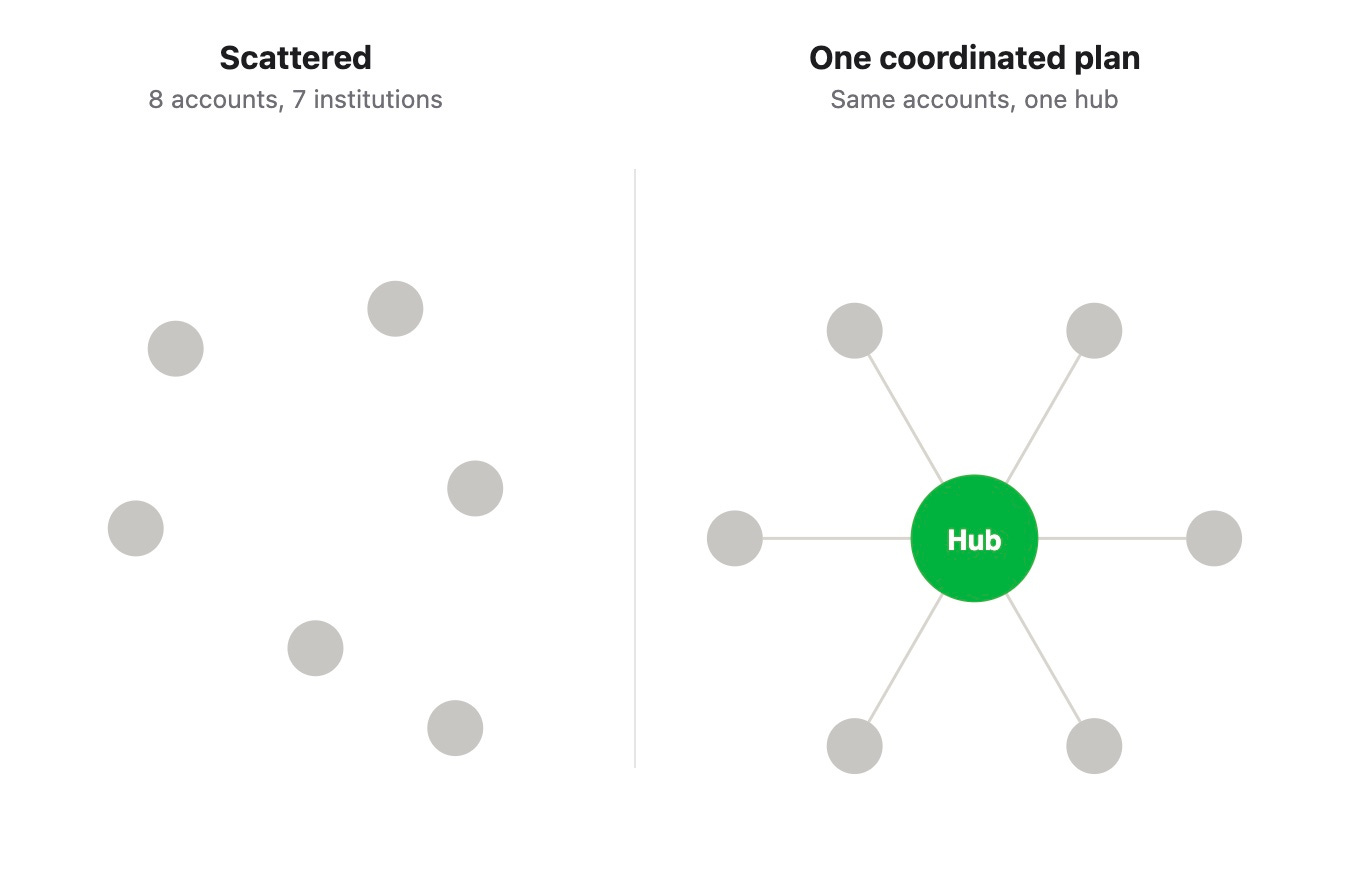
In practice, that looks like:
Rolling old 401ks into your current employer’s plan or an IRA instead of leaving them scattered at companies you haven’t worked for in years
Cutting overlapping brokerage and advisory accounts down to one or two, so your allocation gets managed as a whole instead of account by account
Parking cash in one or two high-yield accounts instead of letting it rot at 0.4% because you forgot the account existed
Making sure whoever manages your investments can actually see everything - not just the slice sitting in front of them
This isn’t about fewer statements to feel tidy. It’s about one plan that knows what it’s actually optimizing for.
The Consolidation Audit
Here’s how I walk clients through this. You can run the same version yourself this week.
Step 1: List every account. Every bank, every brokerage, every old 401k, every robo-advisor you forgot you signed up for. Institution, rough balance, purpose.
Step 2: Check for overlap. Open the actual holdings in each investment account. Look for the same fund, or the same exposure, sitting in three different places under three different names.
Step 3: Flag concentration risk. Any single stock, sector, or old-employer holding above 10-15% of your total investable assets needs a second look.
Step 4: Roll over what’s dormant. An old 401k from a job you left five years ago has no good reason to still be sitting there.
Step 5: Write the “if something happens to me” page. One page. Every account, where the login access is stored (a password manager, not a sticky note), your advisor’s contact info, your beneficiaries, and where the estate documents live. Hand it to your spouse.
This Is About Clarity, Not Control
A lot of people fight consolidation because it feels like giving something up. The extra savings account felt like a cushion. The old 401k felt like “set it and forget it.” A handful of different accounts felt, on some gut level, like diversification.
It isn’t. Scattered is not diversified. Busy isn’t coordinated.
The people who actually build wealth aren’t running the most accounts. They’re the ones who can pull up one page and tell you exactly what they own, why they own it, and what it’s for - without opening a laptop.
That’s not just tidier. It’s calmer. And it’s the difference between money that works for you and money you’re managing around the edges, hoping nothing slips through.
Bottom Line
More accounts almost never means more wealth. It usually means less visibility.
Fragmentation has three real costs: overlap, concentration risk, and no coordinated plan.
A scattered financial life is an estate planning risk for whoever has to pick up the pieces.
Consolidation means the fewest accounts that still make sense, all running one plan - not everything crammed into one place.
Run the audit this week. List it. Check overlap. Flag concentration. Roll over what’s dormant. Write down what your family needs to know.
See you next week.
— Fran


Whenever you’re ready, there are 2 other ways we can help you:
Join The Opulus Method Newsletter — Every Tuesday, I share strategies that help high-income millennials build wealth without sacrificing their life. Join 3,200+ readers.
Work With Us 1-on-1 — We’ll build your personalized strategy to cut your taxes, maximize your income, and grow your wealth month after month. You focus on living your life. We handle the financial strategy and execution.
Opulus, LLC (“Opulus”) is a registered investment advisor in Pennsylvania and other jurisdictions where exempted. Registration as an investment advisor does not imply any specific level of skill or training.
The content of this newsletter is for informational purposes only and does not constitute financial, tax, legal, or accounting advice. It is not an offer or solicitation to buy or sell any securities or investments, nor does it endorse any specific company, security, or investment strategy. Readers should not rely on this content as the sole basis for any investment or financial decisions.
Past performance is not indicative of future results. Investing involves risks, including the potential loss of principal. There is no guarantee that any investment strategies discussed will result in profits or avoid losses.
All information is provided “as-is” without any warranties, express or implied. Opulus does not warrant the accuracy, completeness, or reliability of the information presented. Opinions expressed are those of the authors, Ryan Greiser and Francis Walsh, and are subject to change without notice.
Opulus is not responsible for any errors or omissions, nor for any direct, indirect, or consequential damages resulting from the use or reliance on this information. Use of the content is at your own risk. This content is not intended as an offer or solicitation in any jurisdiction where such an offer or solicitation would be illegal.